Co-author: Irina Rotenko
In April–May 2026 we searched for wolf dens with pups across approximately 1.7 thousand km² of Naliboki Forest. In total, seven breeding groups of wolves were identified. All of them consisted of simple pairs, and no multi‑breeding cases were recorded this year.
During at least the last decade, double‑breeding and occasionally triple‑breeding within a single pack occurred in roughly half of the monitored cases. Multi‑breeding is one of the mechanisms that increases reproductive output in wolves. This spring such a strategy could have been especially important, but only 14 wolves currently persist in the study area, leaving too few individuals to form larger breeding groups as happened regularly before.
One of the seven breeding pairs was unsuccessful from the very beginning because the breeding female disappeared (possibly shot). Over nearly two months of fieldwork, we located dens with pups belonging to four breeding pairs out of the six that remained in the area.
The timing of giving birth appeared normal after a properly cold winter. Births were recorded in the second half of April (three cases) and the first days of May (one case). For comparison, in 2025—after an unusually warm winter—most births in Naliboki Forest occurred already around March (see the separate post for the details).
Three of the actual dens were located in burrows, and one was an open couch. The open‑couch den was monitored with a camera trap for three full 24‑hour cycles. It was situated inside a large treefall (see the separate post for details).


Mother wolf with eight pups on an open couch in the treefall.

Among the burrow dens, two were enlarged entrances of badger setts (one active, one inactive), and one was an inactive beaver burrow. Below you can see two burrow dens situated in forest with only a few fallen trees. One of the dens lay just 98 metres from a frequently used road.


Now you see the wolf den in the badger sett, from which the badgers were displaced by the wolf breeders. This burrow den was located in a meadow on abandoned drained lands.


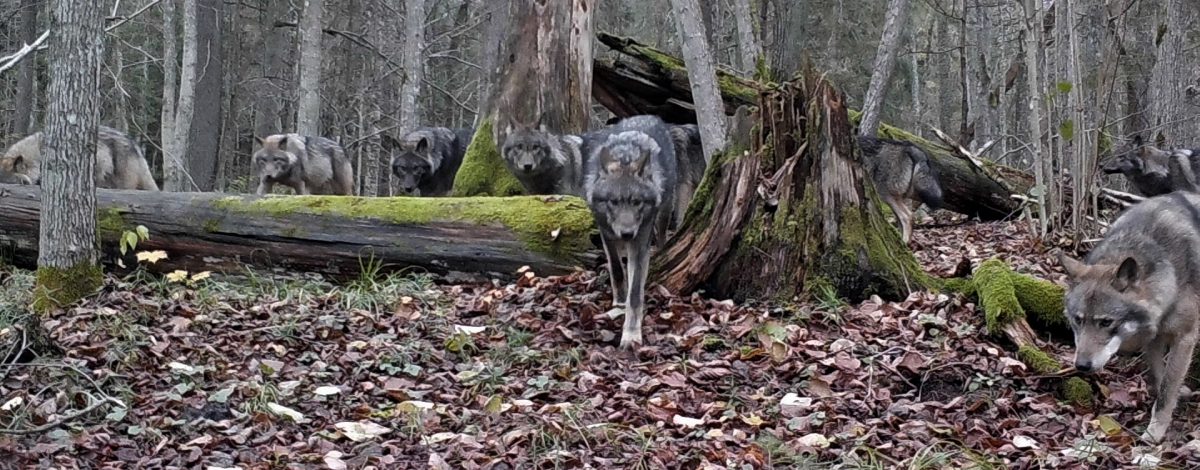
And here are some photos of the wolf parents on their paths near the dens.


A fundraising campaign is now underway to help us publish our new scientific book on wolves. To support this project and contribute to bringing the book to life, please follow the link: https://fr.ulule.com/un-livre-exceptionnel-sur-le-loup