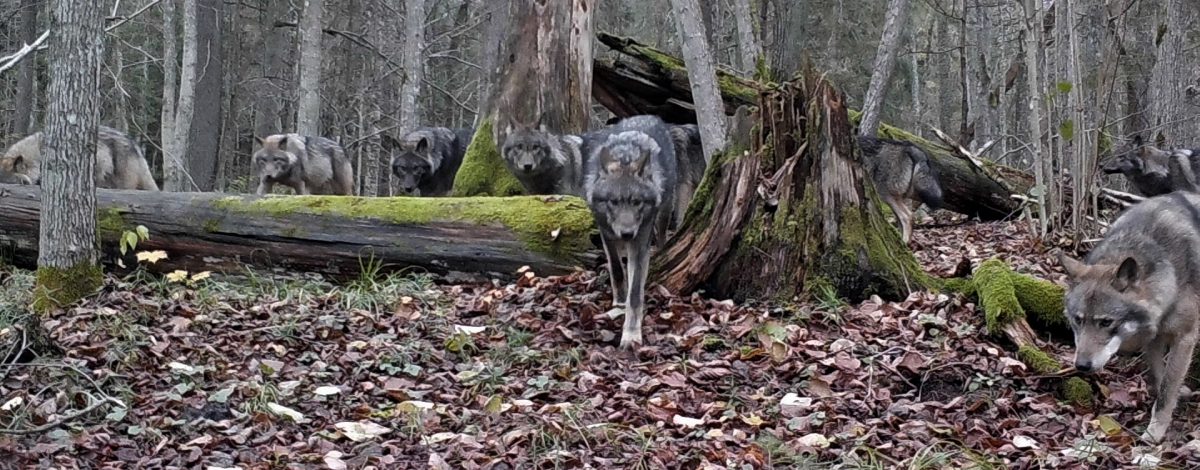
Parental wolves chased a brown bear from the place, where their pups stayed

Co-author Irina Rotenko

In Naliboki Forest, a central-western region of Belarus, a dense population of wolves has long existed. In the past decade, brown bears have expanded into this forested area, raising a pressing question: how do these two large predator species interact? Particularly: the aggressive interference of wolves and brown bears, and how their individual characteristics affect the encounter, is important to investigate.

Continue reading “Parental wolves chased a brown bear from the place, where their pups stayed”

Afeared wolf is investigating a lynx marking spot

Co-author Irina Rotenko

In this blog we have presented our own materials on the interference between wolves and lynxes in Naliboki Forest, the north-western Belarus in several quite large posts before.

Continue reading “Afeared wolf is investigating a lynx marking spot”

Raccoon dogs attacked an adult badger at its outlier

Co-author Irina Rotenko

An aggressive encounter between raccoon dog and badger was documented by a camera-trap at the badger outlier in early June in Naliboki Forest, the central-western part of Belarus.

Continue reading “Raccoon dogs attacked an adult badger at its outlier”

Wolf vandalizes badger sett with badger cubs inside

Co-author Irina Rotenko

In Belarus wolves visit badger setts rather often. Frequently the aim of such visits is to catch a badger that slacked near the burrow. During the breeding season of wolves, quite usually they try to get rid of badgers and occupy their sett. They use such burrows to leave pups inside. Normally wolf breeders enlarge the entrances of such a badger sett.

Continue reading “Wolf vandalizes badger sett with badger cubs inside”

Recovering of the badger local population in Naliboki Forest, NW Belarus, in connection with winter warming and predation by lynxes and wolves

Historically, the badger was a fairly common species in the Naliboki Forest, located in the north‑western part of Belarus. According to information obtained from residents, who were familiar with the forest in the 1930s–1960s (e.g., Baliaslaw Sadowski, Lianard Jurevich, Edzik Khmara), badger setts were widespread. Approximately, the density of main setts – those used by family groups for overwintering, giving birth and raising cubs – was not lower than 15 per 100 km² in the most ecologically rich southern part of the forest, and about 4 per 100 km² in the central and central‑northern parts, where habitat carrying capacity for badgers is markedly lower. This suggests that the former density of a more or less undisturbed badger population in Naliboki Forest ranged roughly between 20 and 120 individuals per 100 km², depending on habitat quality.

Continue reading “Recovering of the badger local population in Naliboki Forest, NW Belarus, in connection with winter warming and predation by lynxes and wolves”