Co-author Irina Rotenko
In this extended post, we analyse multi‑annual (2000–2026) changes in the local badger population in Naliboki Forest, central‑western Belarus, in relation to fluctuations in the population density of the raccoon dog — an exotic invader that affects badgers in at least four major ways: earthing of hibernating badgers inside sleeping chamber of their setts, severe competition for carrion as the main early‑spring food, intensification of shared diseases, killing of small cubs (Sidorovich, 2011; Rotenko & Sidorovich, 2017; several posts in this blog).
Under the pressure of these four raccoon‑dog‑related factors, badgers could theoretically face local extinction in Belarus. However, raccoon dogs themselves encounter serious disease-related problems. Also, the negative impact of raccoon dogs on badgers may be partly mitigated during mild winters, which have become more frequent in recent decades.
Disease cycles in raccoon dogs
When raccoon dogs reach high population densities, infestation by pathogenic helminths (primarily Alaria alata) increases dramatically (Rotenko & Sidorovich, 2017). As a consequence, mange spreads among raccoon dogs weakened by A. alata. Severely impaired individuals become poorly conditioned, suffer high mortality, and largely cease breeding. As a result, raccoon dog numbers decline sharply. During these periods of low raccoon dog density, badgers gain an opportunity to restore their population to some extent.
Roles of wolves and lynxes
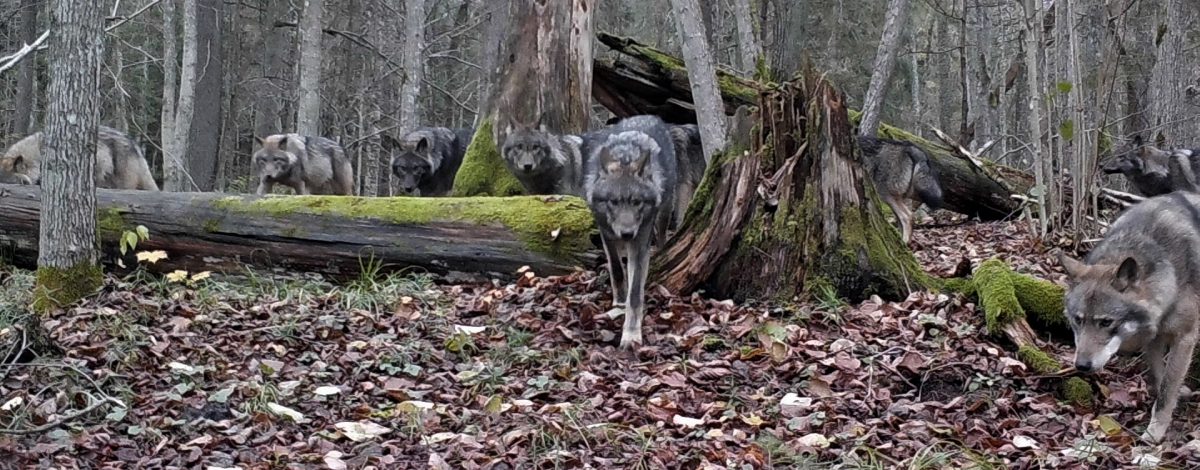
Large carnivores such as wolves and lynxes also play a substantial role in these processes. When badgers are already in decline and occur only sparsely across the habitat, predation by these carnivores has an additional negative effect on the rarefied population. This is especially critical during the mating season, when wolves and lynxes may kill adult male badgers searching for mates, thereby disrupting breeding of the remaining individuals (Rotenko & Sidorovich, 2017). In all other situations, predation by wolves and lynxes does not meaningfully influence badger demography.
Nevertheless, when the raccoon dog population enters a decline phase, predation by wolves and lynxes can help maintain raccoon dogs at a low density for longer. This benefits badgers, allowing them to restore their population, sometimes fully, during these years. If wolf and lynx numbers decrease (often due to persecution by hunters), raccoon dogs, already released from disease pressure during their low‑density phase, escape suppression by large carnivores and begin breeding intensively. Once raccoon dogs reach high population density again, even substantial numbers of wolves and lynxes are no longer able to control their population.
In our book (Rotenko & Sidorovich, 2017), we analysed the above‑mentioned processes and interactions using data primarily collected in Paazierre Forest, northern Belarus. In this post, we demonstrate the same regularities and mechanisms using more detailed and longer‑term materials from Naliboki Forest.
Historical background: raccoon dogs in Naliboki Forest
Raccoon dogs appeared in Naliboki Forest in the mid or late 1960s. By the early 1980s, they had already densely populated the area and seemingly reached the habitat’s carrying capacity. The species remained very common until the late 1990s. During this thriving period, raccoon dog population density varied greatly among localities, and in 1997–1999 we investigated the spatial structure of the population.
The valleys of the Nioman, Biarezina, and Islach rivers, their nearest surroundings, and abandoned peatlands in Masty, Kupalishcha, Khmielishcha, Hala Balota, and Zhurawtsy were the most densely populated (16–28 individuals per 10 km²). Slightly lower densities (10–18 individuals per 10 km²) occurred in several other river valleys (e.g., Vol’ka) and in areas with numerous drainage canals. In contrast, the lowest densities (2–4 individuals per 10 km²) were recorded in localities dominated by pine forests on sandy soils, such as Liakhavyia Hory, Lysyia Hory, Blizniaty, and Siatryshcha. On average, raccoon dog density in Naliboki Forest during 1997–1999 was assessed as 18.9 individuals per 10 km².
Badgers near extinction in the 1990s
The situation for badgers during the 1990s was critically poor. The species was close to extinction in Naliboki Forest. In 1997–1999, we found badger tracks in only three localities. One sett we located was occupied by a single badger. Local hunters and wardens showed us 38 burrows that had been commonly used by badgers in the 1970s and even the 1980s; only three of these were still occupied. In one active sett, a family group lived (three adults and three cubs), while the other two setts held lone individuals.
Early 2000s: raccoon dog decline
In the early 2000s, raccoon dog numbers decreased. For example, in the winters of 2003–2004, average density was only 6.8 individuals per 10 km². The main causes were intense infestation by Alaria alata and widespread mange. According to unpublished data by Dr. Elena Anisimova, all 14 raccoon dogs examined from the southern part of Naliboki Forest (2000–2002) carried thousands of A. alata, and eight were affected by mange. Our own data collected in the same period in the western side of Naliboki Forest suggest that at least one‑third of raccoon dogs were heavily impacted by mange, and 5 out of 7 investigated carcasses contained horrible amount of A. alata. The decline seemingly continued until 2010. In the winter of 2010–2011, population density was very low — roughly one pair per 10–20 km². For example: Hala Balota — 3.7 individuals per 10 km²; Navusts’, Kozie Pienna, Zhdanki, Valiavatka, Aziarskoye — 1.3 individuals per 10 km²; Zabalats’, Pawnochnaye Wiunishcha, Tsiakava — 2.2 individuals per 10 km²; pine‑dominated stands in Lysyia Hory, Blizniaty, Siatryshcha — raccoon dogs were rare and perhaps not resident; Drazdy — 2.0 individuals per 10 km².
2012–2014: short‑term increase, then collapse
In 2012–2013, raccoon dog presence increased, and by March 2013 there were 2-6 inds or 1–3 breeding pairs per 10 km². However, within 2–4 years the population was nearly exterminated due to heavy predation by wolves and lynxes, which had become common in Naliboki Forest. According to the Table, wolves were common during the 2010s, and lynxes reached high density after recovering from severe poaching pressure in the 1990s. Raccoon dogs have always been normal prey for both predators. Yet in 2013, predation pressure intensified sharply due to a sudden collapse in roe deer numbers (March–April 2013) and a dramatic decline in wild boars (March–September 2013). With these key prey species gone, wolves and lynxes increased their killing of raccoon dogs over the usual rate, too.
During intensive studies in autumn 2014, we registered only a few raccoon dog families. The population density likely dropped to one breeding pair per 10–30 km², or plausibly even lower.
Table. Numbers and population densities of wolves and lynxes in Naliboki Forest (2000–2026)
| Year | Wolves (Jan*/May) | Wolf density (Jan/May), inds per 100 km2 | Lynxes (Jan) | Lynx density (Jan), inds per 100 km2 |
|---|---|---|---|---|
| 2000 2001 2002 2003 2004 2005 2006 2007 2008 2009 2010 2011 2012 2013 2014 2015 2016 2017 2018 2019 2020 2021 2022 2023 2024 2025 2026 | 45(?) 43(?) 46(?) 40(?) 36(50-60?) 33(40-50?) 26(40-50?) 29(40) 31(44) 44(42) 56(64) 61(82) 45(72) 56(85) 49(69) 37(31) 26(36) 24(35) 37(29) 22(18) 32(20) 34(17) 30(13) 23(19) 21(15) 24(18) 28(16) | 2.4(?) 2.3(?) 2.4(?) 2.1(?) 1.9(2.9?) 1.7(2.4?) 1.4(2.4?) 1.5(2.1) 1.6(2.3) 2.3(2.2) 3.0(3.4) 3.2(4.3) 2.4(3.8) 3.0(4.5) 2.6(3.6) 2.0(1.6) 1.4(1.9) 1.3(1.8) 2.0(1.5) 1.2(1.0) 1.7(1.0) 1.8(0.9) 1.6(0.7) 1.2(1.0) 1.1(0.8) 1.3(1.0) 1.5(0.8) | – 2 – 1 2 6 9 11 17 21 13 18 24 35 22 27 42 55 84 97 42 48 42 38 40 36 30 | 0 0.1 0 0.1 0.2 0.3 0.5 0.6 0.9 1.1 0.7 1.0 1.3 1.8 1.2 1.4 2.2 2.9 4.4 5.1 2.2 2.5 2.2 2.0 2.1 1.9 1.6 |
* Note: When sufficient snow cover occurred early, winter censuses were conducted in December. In years with late snow, counts were made in January. For consistency, January values are listed in the table.
Figure. Predator dynamics in Naliboki Forest (2000–2026)
Badgers still struggling (2006–2009)
Despite the decline of the raccoon dog population and its eventual reduction to very low density, badgers still struggled to recover. In 2006–2009 we continued to register a deep decline of badgers in Naliboki Forest. The map below illustrates that during this period we already knew 91 badger setts, yet only 8 of them were active, which corresponds to 1.1 active setts per 100 km².
These active setts were only slightly (1–2 individuals) or moderately (3–5 individuals) occupied. Large families were absent. This demonstrates how severely the population had been reduced and how slowly it responded even after raccoon dog pressure weakened.

Badgers in Naliboki Forest in 2006-2009.
Badger recovery during low raccoon dog density (2010s)
However, under conditions of low raccoon dog population density, the badger population in Naliboki Forest gradually began to recover. By 2019, badgers had reached a rather high density. That year we already knew 110 badger setts, and 102 of them were active, which corresponds to 14.5 active setts per 100 km².
Badger families clearly prevailed in the active setts. We recorded 33 medium‑sized families (3–5 individuals; 32% of active setts) and 25 large families (6 or more individuals; 25% of active setts). The distribution map below illustrates this substantial recovery and the spatial pattern of sett occupancy.

Badgers in Naliboki Forest in 2019.
Regarding raccoon dogs, they were still rare in Naliboki Forest in 2019. We censused only 0.5 overwintering raccoon dog pairs per 10 km² (see the distribution map below).
Late 2010s–2020s: predator decline and raccoon dog explosion
Toward the end of the 2010s, the numbers of wolves and lynxes began to decrease sharply (see the Table), and raccoon dogs started breeding intensively. As a result, their population increased dramatically. The distribution map for 2026 clearly illustrates this rapid expansion.

Overwintering raccoon dog pairs in Naliboki Forest in 2019.
In late winter and early spring 2026, within an area of 700 km² in Naliboki Forest, we registered 171 overwintering raccoon dog pairs, which corresponds to 2.5 pairs per 10 km². However, this census was done in between, while doing another studies on wolves and lynxes. Considering territorial coverage, we assume that the real density of raccoon dogs in Naliboki Forest in 2026 may be up to 10-fold higher. Anyway, the gained even underestimated data showed a sharp increase in the number of raccoon dogs following the substantial decline of wolves and lynxes in the late 2010s and early 2020s.

Overwintering raccoon dog pairs in Naliboki Forest in 2026.
Badger decline again (2025-2026)
Under conditions of once again high raccoon dog population density, the badger population in Naliboki Forest began to decline. In 2025, although we still knew the same 110 badger setts, only 93 of them were active, corresponding to 13.3 active setts per 100 km².
The number of badgers in active setts also decreased slightly compared to 2019. Medium‑sized families (3–5 individuals) declined from 33 to 29, and large families (6 or more individuals) declined from 25 to 20. Nevertheless, the proportion of family groups remained nearly the same. In 2025 we recorded 29 medium families (3–5 individuals; 32% of active setts) and 20 large families (6 or more individuals; 18% of active setts).

Badgers in Naliboki Forest in 2025.
During the following year, the decline in the badger population continued. Within just a single year, 25 badger setts that were still active in 2025 disappeared — a loss of 27%. In 2026, across 700 km² of Naliboki Forest, we found only 66 active badger setts, corresponding to 9.4 active setts per 100 km².
The number of badgers in active setts decreased markedly compared to 2019. Medium‑sized families (3–5 individuals) declined from 33 to 24, and large families (6 or more individuals) declined from 25 to just 6. The proportion of family groups also decreased. In 2026, we recorded only 6 large families (6+ individuals), representing 9% of active setts.

Badgers in Naliboki Forest in 2026.
Conclusion
The long‑term materials collected in Naliboki Forest fully support the statements given at the beginning of this post. Once again, it is evident that the raccoon dog plays a detrimental role in badger population dynamics. When raccoon dogs reach high density, their combined impacts (competition, disease intensification, cub killing, and interference during hibernation) suppress badger numbers severely.
At the same time, wolves and lynxes can play both negative and significantly positive roles in badger demography. When badgers are already rare, predation by these carnivores may further reduce the population. However, during periods of raccoon dog decline, wolves and lynxes help maintain raccoon dogs at low density, thereby creating favourable conditions for badger recovery. The interplay of these three species — raccoon dog, wolf, and lynx — forms the core mechanism shaping badger population dynamics in Naliboki Forest.