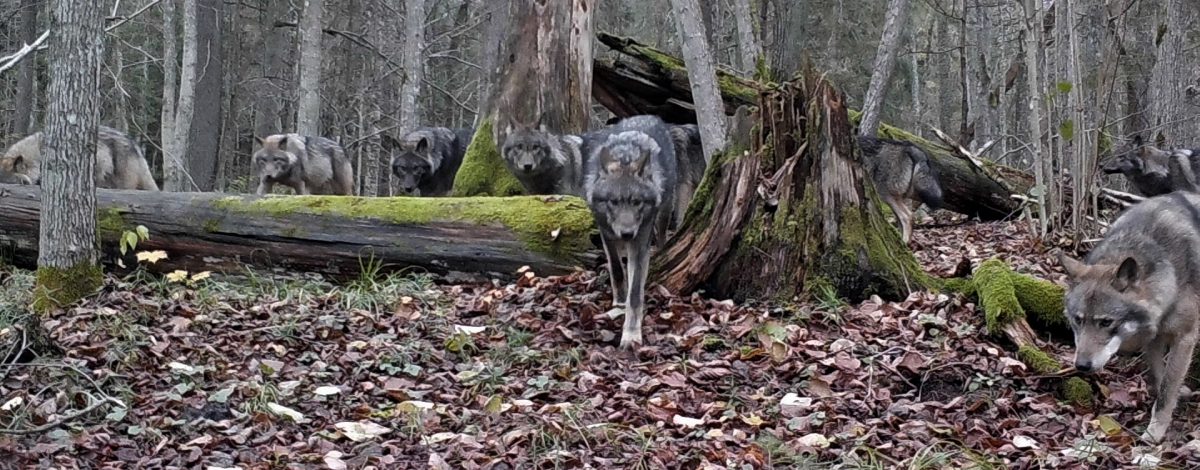
Co-authors: Louise Giovannelli and Irina Rotenko
In Belarus, female wolves typically give birth between the end of April and the end of May, with about two-thirds of litters emerging by May 10th. Before 2010, significantly earlier parturition was very rare.
Since roughly 2010, however, the timing of wolf breeding in Belarus has shifted noticeably toward earlier births. We investigated this trend in the Naliboki Forest, in the central-western part of Belarus.
During the springs of 2015–2023, our study of 3 to 6 breeding groups per year (using both den searches with pups and camera traps) recorded the following instances of early parturition:
- (1) one case in mid-January;
- (2) one in late January;
- (3) one in late February;
- (4) mid-March;
- (5,6) 2 cases in late March;
- (7-9) 3 cases in the early April.
For our study, “early parturition” is defined as any birth occurring before April 10th. Over these nine years, we documented nine cases of early breeding among a total of 38 wolf parturition and litter-rearing events in the area. Thus, early breeding among wolves in the Naliboki Forest has become increasingly common over the past decade, now constituting 23.7% of all cases.
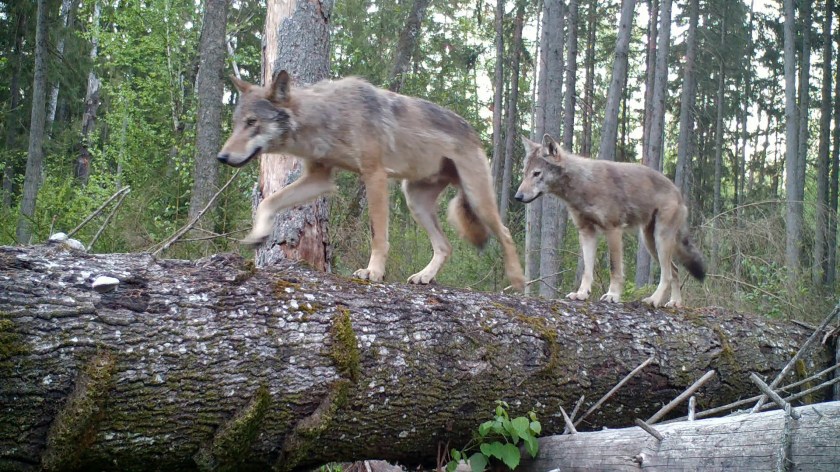
Adult wolf with a pup observed in late May (with the pup born in late January)
In 2023, we tentatively linked this trend to increased hybridization between wolves and stray dogs, a phenomenon that had been observed since 2010 and was the only plausible cause at that time.
However, in the spring of 2025, among eight parturition events observed, five were classified as early (one at the beginning of April, three in March, and one possibly in the latter half of February). Such a high frequency of early breeding in Naliboki Forest can no longer be attributed solely to stray dog hybridization. In addition, we have not detected any cases of such hybridization over the past three years.

The wolf pups, which were born in the late February, resting in grooming spot on 2nd July.
Our new hypothesis is that the unusually warm winter of 2024–2025, characterized by little or no snow and higher temperatures (especially during the first half of winter), has prompted considerably earlier mating in wolves. In contrast, the winter of 2023–2024 was relatively cold, with consistent snowfall and frost, starting in mid-November. Consequently, all three wolf litters studied in spring 2024 were born at the end of April or during early May.
 Zoology by Vadim Sidorovich
Are these early breeding cases due to the climate change ?
JC Génot
LikeLike
Thanks, possibly. Warm regards, Vadim
LikeLike
Thanks for the update. I also have the impression that whelping has been happening about two weeks earlier in “our” territories in recent years. Although I can’t prove this 100%, because I leave the denning sites alone, camera footage does show a shift. The lactating females appear in front of the cameras earlier than they did a few years ago.
Warm regards, Gerard
LikeLike