The Zadrach research station was established in 1995 with the purchase of a modest peasant house (the brown one). It is located in the Zadrach hamlet, Haradok district, Vitebsk region, in northeastern Belarus. A second house (the green house) was constructed in 1996, and both were adapted for living quarters and wildlife research. Nestled within the densely forested upper reaches of the Lovat River, the station became a base for ecological studies.

A Mission Rooted in Conservation
In the mid-1990s, the upper reaches of the Lovat River were home to a thriving population of European mink (Mustela lutreola), a critically endangered species. The primary goal of establishing the station was to study this species’ ecological traits and understand the reasons behind its decline. These efforts were led by the Belarusian team from the Institute of Zoology at the National Academy of Sciences of Belarus and culminated in intensive research until the species’ disappearance in the early 2000s.


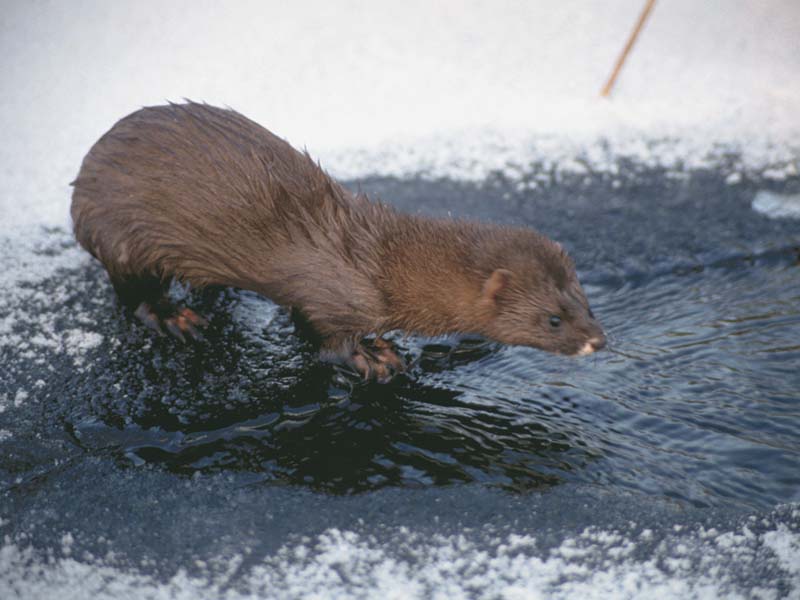

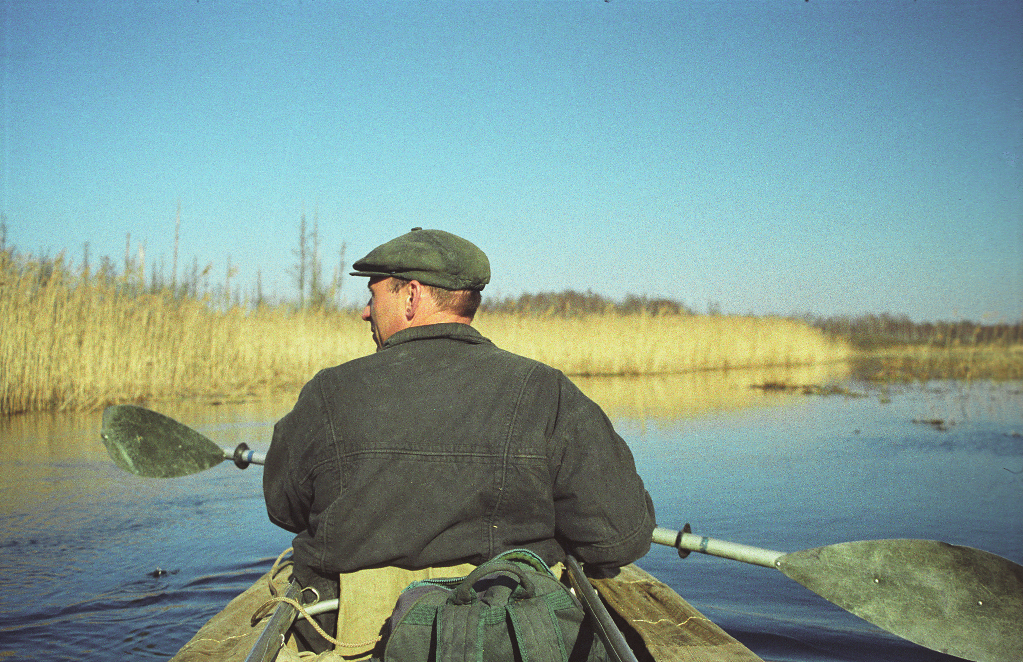
Between 1995 and 1997, the station welcomed collaboration with eminent zoologists from Oxford University’s Wildlife Conservation Research Unit (WildCRU), including Professor Dr. David Macdonald and Dr. Hans Kruuk. This partnership was a transformative experience for the Belarusian team, made possible through support from the UK’s Darwin Foundation. There were applied the whole variety of available research methods of mammal population ecology including a lot of radiotelemetry. Over the course of their studies, 38 European minks (18 tracked long-term), 69 American minks (Neovison vison), and 19 polecats (Mustela putorius) were radio-tagged.
These findings were published in a series of academic articles and three books:

D.W. Macdonald, V. Sidorovich, T. Maran, H.Kruuk. “European mink, Mustela lutreola: Analyses for Conservation” – Oxford, WildCRU and Darwin Initiative, 2002.

Sidorovich V. “Analysis of vertebrate predator-prey community. Studies within the European Forest zone in terrains with transitional mixed forest in Belarus” – Minsk, Tesey, 2011.

Sidorovich V. “Mustelids in Belarus” – Minsk, Zolotoy Ulej, 1997.
Expanding Research Horizons
Following the main European mink project, the station served as a key base to investigate the vertebrate predator-prey community in the transitional mixed forests shaped by the last glaciation. This broad research direction dominated activity in the Lovat study area between 1997 and 2013.
During this time, only one major project (2001–2005) was completed, financed by the budget of the Institute of Zoology NAS Belarus. In addition, several narrower studies were conducted, contributing significantly to the broader understanding of predator-prey dynamics. These included:
- Telemetry and other studies on badger, raccoon dog, and red fox, examining implications for the decline of badgers.
- Analysis of the rodent eater guild.
- Study of the owl assemblage, with detailed investigations of three Strix species.
- Impact of beaver construction activity on small river ecosystems, exploring how this affected semiaquatic mustelids.
- Predation impact of the American mink on water voles and the native predator guild of water vole eaters.
- Population density and diet studies of diurnal raptors.
- Census of amphibians and reptiles, providing crucial baseline data.
- Population density and diet research on large carnivores.
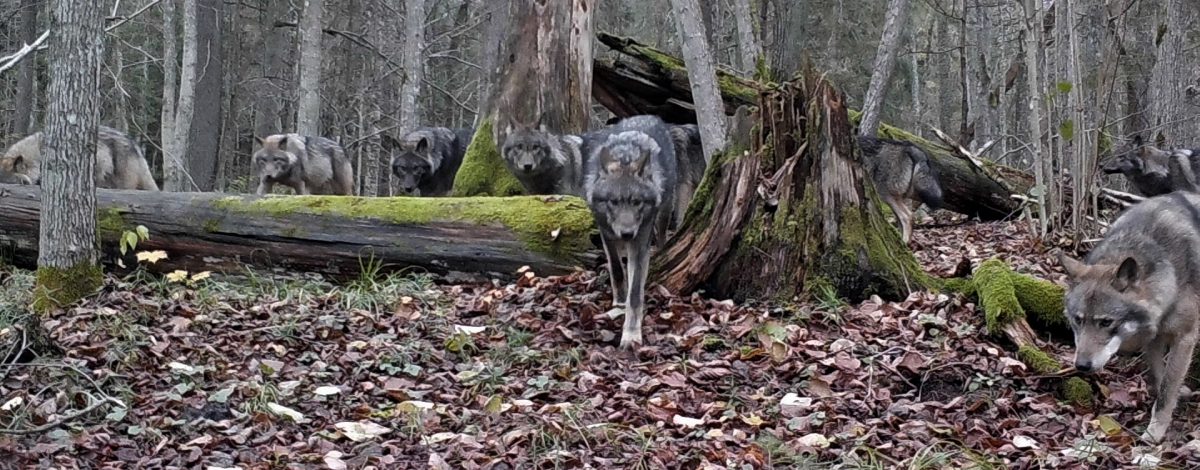
- Wolf breeding studies, adding to knowledge of their reproductive ecology.
The results of these studies were published in numerous articles and the book Analysis of Vertebrate Predator-Prey Community (2011).
Sidorovich V. “Analysis of vertebrate predator-prey community. Studies within the European Forest zone in terrains with transitional mixed forest in Belarus” – Minsk, Tesey, 2011.
The Station’s Decline and Closure
In 2015, I made a significant shift in my career and life. I left my position at the Institute of Zoology NAS Belarus and moved to Naliboki Forest, a densely forested area approximately 520 kilometers away from the Zadrach research station. This relocation marked a turning point in my ability to conduct intensive studies in the Lovat area. The distance posed considerable challenges, making it impossible to continue the regular, detailed research that had defined my earlier work at Zadrach.
Over the following years, I could only manage short visits to the station, typically once or several times per year. During these brief visits, my studies focused on bears living in abandoned villages with orchards—a somewhat limited scope compared to the expansive vertebrate research previously carried out. However, these trips highlighted a growing problem: the lack of consistent maintenance for the Zadrach houses and facilities. Gradually, both buildings began to deteriorate.
As time went on, my ability to visit Zadrach nearly collapsed entirely due to several compounding reasons. The logistical challenges of traveling such a distance, combined with changing priorities and constraints, led to fewer and fewer visits. By January 2025, the situation had reached a critical point, and the decision was made to sell the Zadrach station. The property was sold for a meager price, amounting to only about 5% of the total investment poured into it throughout the entire study period. This marked the end of an era for the station—a poignant conclusion to a site that had once been at the forefront of ecological research.


 Zoology by Vadim Sidorovich
I remember you telling me about it, … the research station too far east to visit, but what seemed to me a very special place. I had the quiet hope of seeing it someday….
You will have many great memories there, beautiful studies. It is nice that you want to give this place the attention and respect it has obviously earned. However, it is disheartening that the situation has now reached the point where you have had to part with this too.
Warmly,
Gerard
LikeLike
Thank you, Gerard. I am sorry that you have not been there. It is really wonderful, ecologically rich area. Warm regards, Vadim.
LikeLike
So sad to read this , it was the first place I ever visited in Belarus and have a lot of good memories of this field station , I love the surrounding area too , I remember once I went for a walk in a nearby forest and was gone for hours , when I got back you and Grisha asked me where I had been so I pointed to where on a map then you and Grisha laughed at me because I walked into Russia by mistake , I also remember the Otter surveys we done on the river Lovat , sleeping in abandoned houses while looking for Bears , the end of planet and many other places close by , so many good memories of this place that will stay with me forever , I know this place was a big part of your life and I feel it was a big part of mine too , I shall miss this place , good bye Zadrach
LikeLike
It makes me so sad to read to this , Zadrach was the first place I stayed in when I first came to Belarus , at the time little did I know that it would change my life forever , I have so many memories that where built here , I remember you and Grisha laughed at me when I went for a walk in the forest alone and ended up in Russia by mistake , I remember the beautiful winters , the lake where I would sit and relax , the Otter surveys we done on the Lovat river , sleeping in anbandoned houses while looking for Bears , the nearby end of planet and so many more memories , such a very special place that I know played a big part in your life , I feel it played a big part in mine too , I shall never forget the good times I had there .. goodbye Zadrache I will really miss you
LikeLike
Thank you for your kind comments. I know John that Zadrach station and the Lovat area was lovely place for you, where you have been many times. However, our life and the whole situation went by the way we could not be there anymore. We sold the station for pretty small price to good people, who perhaps will renew life in the place. Warm regards, Vadim
LikeLike
Hallo Vadim,
It is a long time ago that we were in contact. It was a a special occasion to visit you (and the Zadrach station) in about 2002. When Addy de Jongh was working over there, life-trapping otter for reintroduction into The Netherlands. It was a succes, by now the otter is not in the list of endangered species anymore. Though the reintro took place somewhere in the middle of the country, some otters have come far to the west, to the coast by now. Some moths ago one was on a wildlife-camera, just a km from the sea, in a dune-lake.
But there is too much traffic and there live too many people in the western part (“Holland”). So when an otter comes to the western part, they are alone and they keep roaming around …
Anyway, it was nice to find this blog and I hope you are doing all right.
Regards Fred Barends.
LikeLike
Dear Fred, thanks for the message. Yes, I remember you and the project. It has been nice time. Nowadays I live with my family in a huge forest of Naliboki studying lynxes and wolves. Warm regards, Vadim
LikeLike
And there is one thing more: still can remember the enormous amount of bugs which were flying around at night, while trying to get asleep. When there is one, it comes for me, let alone when there are a hundred! FB
LikeLike