
Co-author Irina Rotenko
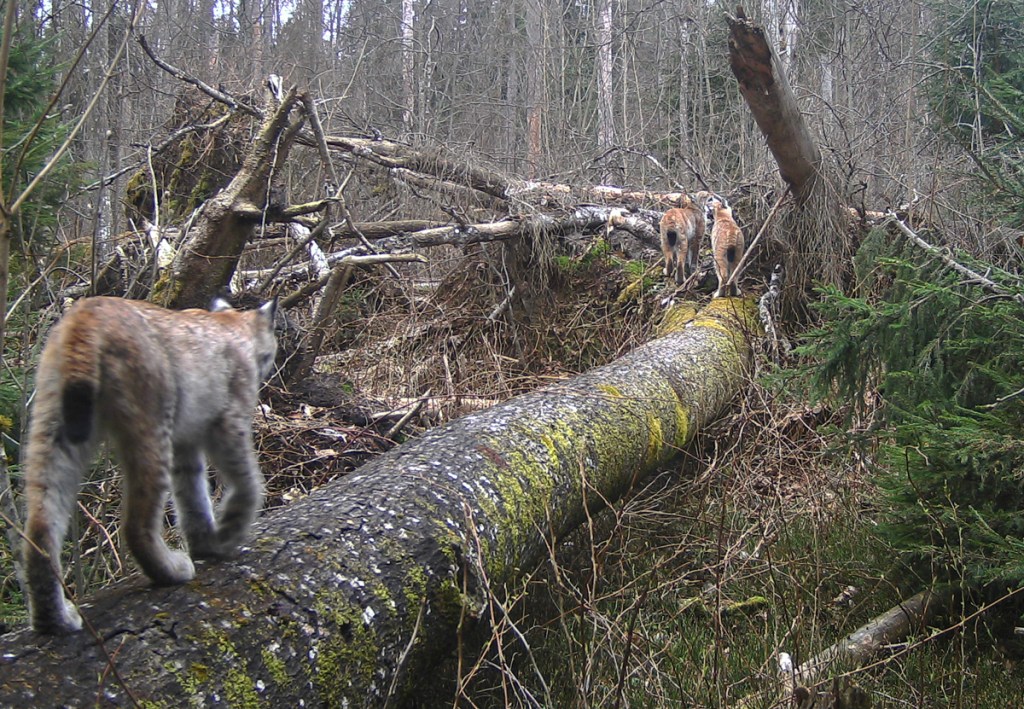
Today in Naliboki Forest we revealed one more case of lynx kitten stays with the mother in the mid-April.
In the literature that advert to the question of natal dispersal of Eurasian lynx kittens we found a quite different information. Schmidt et al. (1997) stated that in the Polish part of Bielaviezha Forest (actually it is not far away from Naliboki Forest), lynx family breakup coincides with the lynx mating season in February-March, and that the dispersal of subadults (all radio-tracked subadults left the maternal home range just after separation from the mother) may be provoked by the intolerance of adults (the mother or a male in heat). In Switzerland, independence of the kittens began from January to the beginning of May with a peak in April, at an age of 8.1 to 10.7 months. After independence, the kittens stayed a few days in the maternal home range (Haller and Breitenmoser, 1986; Breitenmoser et al., 1993a; Zimmerman et al., 2005). According to Zimmerman et al. (2005), the mating season may be one of the causes affecting the onset of independence, not through aggression as Schmidt et al. (1997) stated, but by the females abandoning their kittens at a kill. Gradual loosening of the contact between the mother and her kittens by abandoning them at kills has also been suggested by Molinari & Molinari-Jobin (2001), based on observations of a single lynx family at kills.
Our own statements that are based on the gained materials are following. Lynx yearlings separate from their mother in spring just before, or (more often) 1-2 months after the mating season. Some yearlings disperse right away, others hang around in the vicinity of their natal home range a little longer. Generally, we think that during the next autumn or winter, a part of lynx mothers accept some of their kittens of the previous biological year (i.e. subadults), if they are still roaming within their home ranges. Sometimes, a mother lynx accepts subadults already in mid-summer. When the mother goes foraging, the subadult follows her, while the small kittens are left in a refuge. Reacceptance of subadults in the family by the mother may lead to a higher survival of both subadults and kittens of the year.
As to dispersal timing of lynx kittens, we have got strongly suggest that in Belarus mother lynxes only temporarily abandon kittens during the days that the mother goes mating. We can say that for 39 well-traced cases, at least. At the same time we did not face with a situation, when all kittens disperse during mating of their mother. Maybe only some of them disperse at that time.
For 31 cases we could count the number of kittens staying with their mother before and just after her mating. We found that the mother lynxes recollected 84% of their kittens after mating time. 16% of the kittens either disperced or died. For those cases only three kitten carcasses were discovered by us in the places, where they stayed during mating of their mother. It looks like one of the kittens died from starvation, while two of them were killed by an adult lynx, probably the mate of their mother. All the above data suggest that only one of ten kittens disperse during mating of their mother in our study areas in Belarus.
By snowtracking, we were able to follow with an accuracy three situations of mother’s leaving and recollecting of her kittens. All 2, 2 and 4 kittens joined their mothers again after 5, 7-10 and about 7 days of staying alone. Most likely to say that the mothers were mating during these days.
In general, in Belarus it is not rare to encounter tracks of mother lynxes with kittens in March and early April, and sometimes even in the second half of April when snow cover persists. Over more than 30 years of fieldwork in lynx habitats in April, we have registered such family groups around 63 times (mostly by tracks, but also visually). The latest observations were on 22 April (a mother with three kittens) and 26 April (a mother with two kittens).
Camera trapping in Naliboki Forest supports the same conclusion: reacceptance of kittens after the mating season is common. In mid‑April and even late April, family groups with two or three kittens have been photographed.
 Zoology by Vadim Sidorovich
You’ve made some wonderful observations again, Vadim and Ira.
If I’m not mistaken, you’ve even documented a subadult joining a family that wasn’t born to the mother lynx.
Warmly, Gerard
LikeLike
Yes, it happened. Thanks.
LikeLike