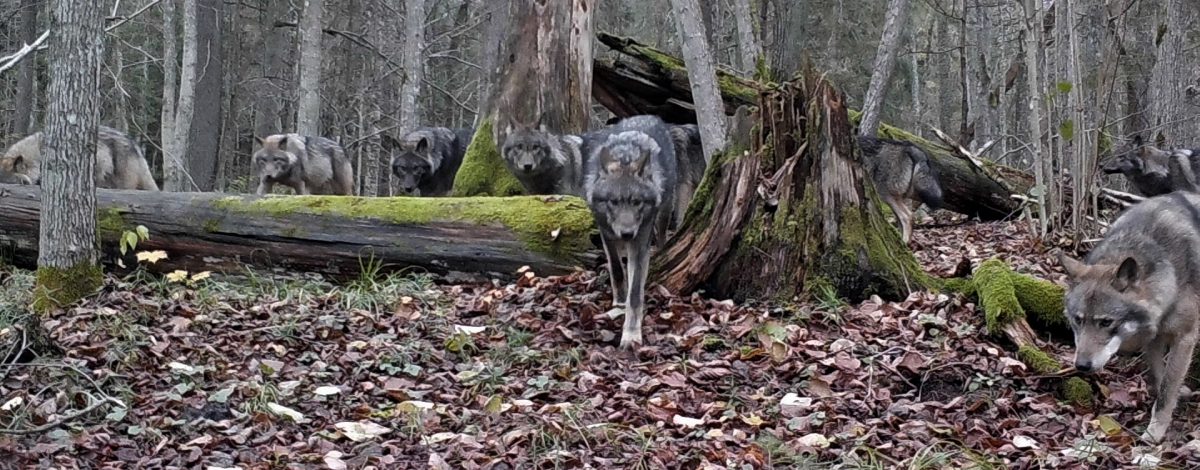
In Naliboki Forest in May-June 2025 within an area of only about 140 km², we recorded three distinct wolf families (each with pups) living in exceptionally close proximity throughout the denning season. One of these families had two simultaneously breeding females (double-breeding), two of them had one litter each, while a separate group of four non-breeding adults and subadults lived there, ranging between the families. We define this newly observed social structure during breeding season as a breeding clan.
We hypothesize that this exceptionally cooperative and intensive breeding behavior is underpinned by an unprecedented surplus supply with prey. The area has long been rich in red deer, roe deer, beaver and wild boar. But in recent years, a massive surplus of easily accessible prey (specifically around 300 tarpan-like horses and at least 800 sheep) has transformed the local foraging area. Wolves now take this prey with ease.
These wolves coexisted for three months with minimal signs of aggression.
I was very curious to see how the wolf breeding clan would develop. To investigate, I monitored activity signs and deployed up to 18 camera traps. Although the findings were limited, several interesting details emerged:
(1) In late July-August all pups from the four litters roamed either alone or in small groups of up to four, within a densely forested area of 8–12 square kilometers.
(2) All parents carried food into the pups’ area, seemingly feeding whichever pups they encountered, regardless of parentage.
(3) In early September, a farmer relocated a large sheep herd due to heavy losses from wolf predation. By mid-September, the wolves began forming two large groups, positioned on opposite sides of the horse locality.
(4) Each wolf group contained a random mix of pups originating from all parents.
 Zoology by Vadim Sidorovich
This strategy of “nursery of pups coming form different wolves families” is maybe a response to different threatens and culling of hunters
JC
LikeLike
Maybe, but the clan stayed in the area with no hunting.
LikeLike
I might have misunderstood some parts of the description🤔. Could you clarify whether the article suggests that the pups broke down family boundaries and formed a mixed “juvenile group,” allowing pups from different families to move into each other’s activity areas? Or does it imply something else?for example, does the statement “Each wolf group contained a random mix of pups originating from all parents” mean that adult wolves had previously been stealing pups from one another? Also, did parent wolves enter other families’ territories—perhaps incidentally—while moving around and end up feeding pups they encountered there?
LikeLike
In the case of the wolf breeding clan I found that already since the mid-July all the pups from four different litters mainly roamed in an area more or less about 10 square km. It was like a pup mess. They roamed lonely in two third of cases or they created temporal groups up to four pups. I gradually got convinced that the parents could not sort out where their own pups or where pups of other parents. Therefore, a parent just fed any pups it found first. It was not rare that a parent fed a pup of other parents. All parents and at least a half of pups were recognisable. As to autumn packing, The packing pattern suggests that it was a random joining of pups by already packed adults. I think they accepted pups that they met on the way.
LikeLike