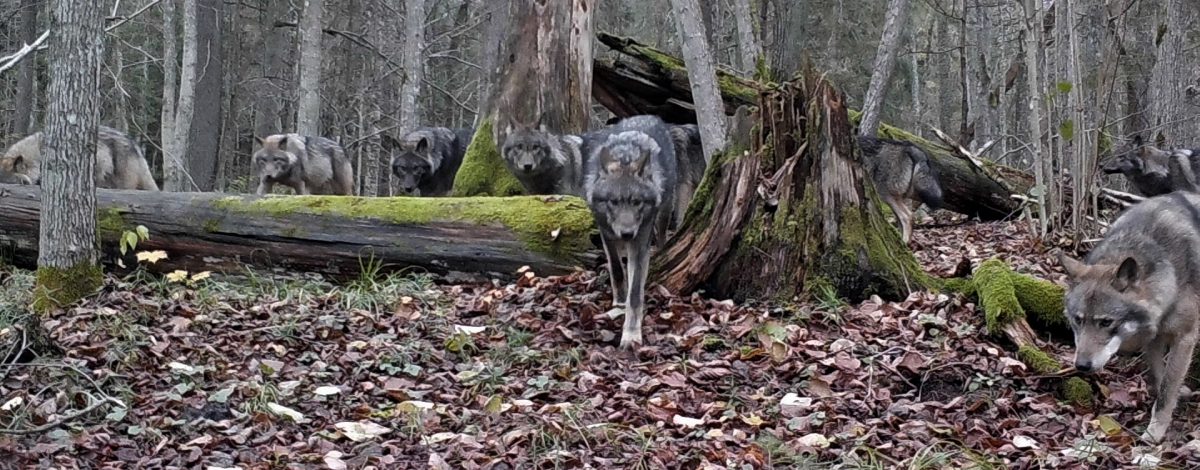

In Belarus during many years of study on wolves in the early summer (May-June), when I was investigating denning in wolves, I noticed numerically that wolves roll in engine oil on forest roads once and again. The same red foxes do sometimes. Lynxes do that, too. Later in July-September wolves and other carnivores almost stop this habit.
Continue reading “Why do wolves roll in engine oil on forest roads during early summer?”
Why do lynxes visit road pipes?

In Belarus lynxes quite often visit road pipes. In the warm season, they mainly use road pipes without running water. In winter, when water is covered with ice, almost all pipes that are large enough are in lynx usage.
Trends in the denning behaviour of the wolf and lynx in connection with the changes in the vertebrate community in Naliboki Forest (north-western Belarus)
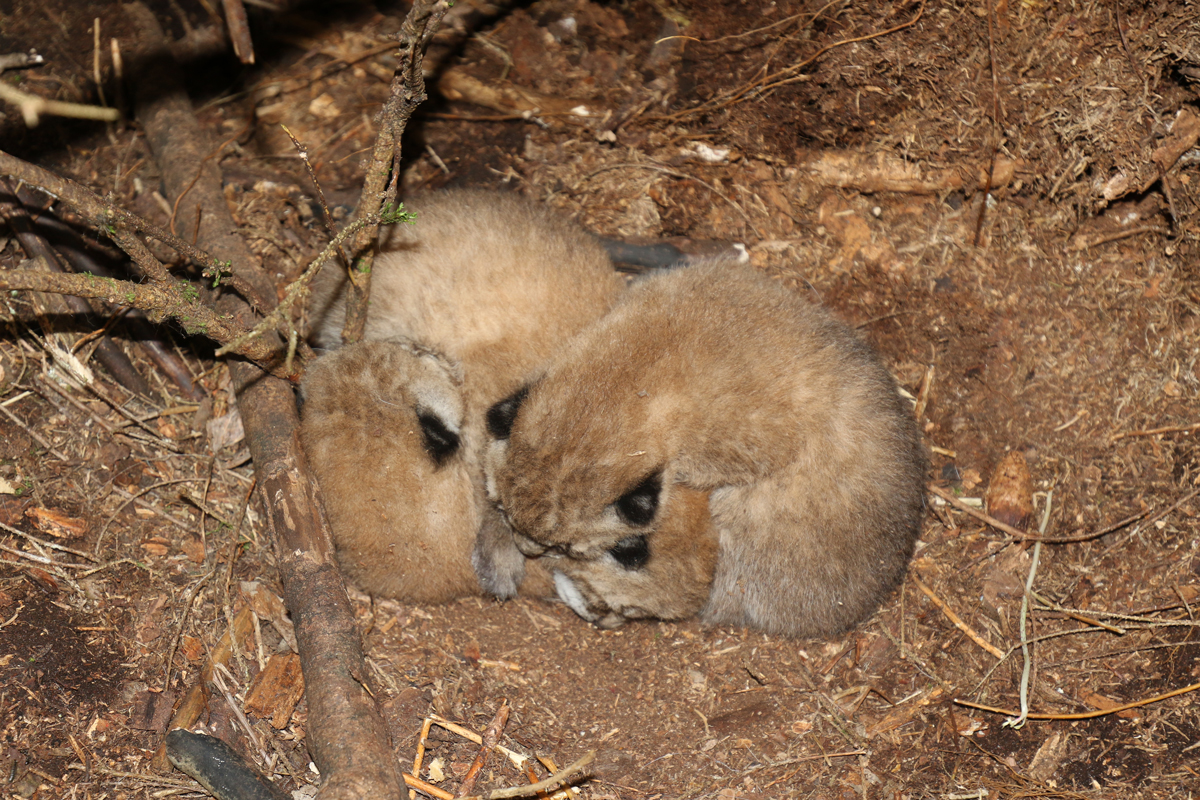
By investigating the denning behaviour and ecology of wolves (Sidorovich and Rotenko, 2018) and lynxes in Naliboki Forest, we faced with several evident trends during the last years (2016-2018) that we connect with the changes in the local vertebrate community or more specifically with the pronounced changes in the population densities of those species that may affect the denning conditions for wolves and lynxes.
Continue reading “Trends in the denning behaviour of the wolf and lynx in connection with the changes in the vertebrate community in Naliboki Forest (north-western Belarus)”
Seemingly strange in the wolf life things
Wolves frequently use surprising things such as plastic or glass bottles, metal or plastic cans, rubber or leather boots, bones, antlers etc. They carry them, gnaw them, play with them, demonstrate them to another wolf etc. In my research practice on wolves I registered such a wolf behavior for many times, and gradually I started […]

Wolves frequently use surprising things such as plastic or glass bottles, metal or plastic cans, rubber or leather boots, bones, antlers etc. They carry them, gnaw them, play with them, demonstrate them to another wolf etc. In my research practice on wolves I registered such a wolf behavior for many times, and gradually I started realizing, why wolves deal with the mentioned seemingly strange things. I might be not entirely right in the ideas, but anyway would like to share them as well as the photos taken.
Continue reading “Seemingly strange in the wolf life things”
The causes of long-term decline in the polecat population in Belarus

Population decline of carnivore species may happen suddenly, develop rather fast and proceed short-term. For instance, such demise character was known for the European mink in Belarus and Russia (Macdonald et al., 2002; Sidorovich, 2011). Population decline of other carnivore species may pass gradually and less evident, and a considerable decrease in population density may take many more years.
The situation that is characterized by gradual and long-term decline is fairly hard to notice, while manipulating short-term data only. It takes much time to establish a right hypothesis on the decline and to prove the hypothesis. Usually, in such a case, when a population decline appeared to be evident, it is already too late to get a complete dataset to analyze the declining process and to reveal the factors that impacted the population. The polecat Mustela putorius population decline in Belarus was characterized by the mentioned features of gradual and long-term decline (see Sidorovich, 2011). Our results of the study on the polecat demise suggest the following negative factors that are responsible for the population decline.
Continue reading “The causes of long-term decline in the polecat population in Belarus”
Interference between the badger and raccoon dog in Belarus

A year ago, while publishing the book about badgers and raccoon dogs in Belarus (“Badger and Raccoon dog in Belarus: Population studies with implication for the decline in badgers“, Minsk, 2017), it looked like we knew all possible ways of interference between raccoon dogs and badgers. We registered blocking badgers sleeping in the sett’s hibernating chamber by raccoon dogs with suffocating of the badgers afterwards; killing of badger cubs by raccoon dogs; non-effective attacks of badger on raccoon dog at its sett as well as a lot of marking of badger setts by both species in order to prevent usage of the sett by the burrow-competitor species. Any attack of an active badger by raccoon dogs was not registered, and that was considered as something non-real.
Continue reading “Interference between the badger and raccoon dog in Belarus”
Impact of American minks on water vole and root vole populations and populations of the aboriginal predators – eaters of these beneficial prey, in particular, the stoat and great grey owl

In one of our study area on the question, which is the Lovat terrain in Paazierre Forestin northern Belarus, both riparian vole species (the water vole Arvicola terrestris and root vole Microtus oeconomus) have become scarce since the American mink Neovison vison has established a dense population. Continue reading “Impact of American minks on water vole and root vole populations and populations of the aboriginal predators – eaters of these beneficial prey, in particular, the stoat and great grey owl”
Mating in Eurasian lynxes

Mating in Eurasian lynxes and other questions in relation to that (such as pre-mating activity; life of kits, when their mothers go for mating; others) are quite poor investigated (e.g. Schmidt et al., 1997; Schmidt, 1999; Jędrzejewski et al., 2002; Breitenmoser-Würsten et al., 2007; Samelius et al., 2012). The scarce information published on the question shows that these complicated mating-related actions in Eurasian lynxes are too simplified, while researchers mention about mating in lynxes. Let’s say there is evident gaps in the lynx-related literature on the species mating.
How to distinguish tracks of wolves and dogs

Sometimes, it may be hard to differentiate tracks of the wolf and large domestic dog. Usually wolf footprints are bigger than those of dogs. Footprints left by wolves on a thin snow cover or loose ground are 8–13 cm long and 6–9 cm wide, whereas in the conditions of a loose snow cover these dimensions may be slightly higher. Prints of wolf digital pads are symmetric and oval, whereas in dogs they are frequently wider in rear part than in the front part. Male wolf has wider footprints than those of female wolf. Ratio between length and width comprises about 1.3 in footprints of male wolves, and approximately 1.5 in those of female wolves. In wolf footprints all digital pads look more massive than those of dogs in relation to the interdigital pad, even of large ones, and the two central digital pads in wolf footprints are mostly placed in front of the lateral digital pads. However, in a big male wolf the later feature is not pronounced, and this may be used for rough distinguishing of males and females among adult wolves by their fore footprints. The central digital pads are also placed tighter to each other in wolf footprints than those of stray dogs.
However, these observations are not totally reliable. Nowadays, some big dogs have big paws and rather massive digital pads like those of wolves. Continue reading “How to distinguish tracks of wolves and dogs”
Scaring lynxes away from their kills by wolves

Recently I faced with the next fourth case of scaring lynxes away from their kills by wolves and decided to prepare this post about this curious way of the species interference. This fourth registered such a story was outstandingly rich on events and relatively well photo-documented, therefore, I will begin just with that story.
In the story the main acting persons were Els Lavrysen and Hans Van Loy, a couple of lynx amateurs from Belgium, who faced the case of scaring lynx family away from the roe deer carcass by two wolves in Naliboki Forest (the central-western part of Belarus). Continue reading “Scaring lynxes away from their kills by wolves”
 Zoology by Vadim Sidorovich