Co-author Irina Rotenko
Introduction: Bear Recolonization and Lack of Reproduction
Since April 2011 brown bear began re-colonizing Naliboki Forest, where in the past the species was common. During the summer of 2018, consistent observations (mainly via camera traps) revealed seven large male individuals and one or two smaller ones of uncertain sex (presumably females, inferred from the lack of visible testes). From 2020 to 2022, in the Naliboki Forest, we identified ten to twelve brown bears, about half of which (4–7 individuals) did not have visible testes, indicating they were likely females. Despite detailed tracing of the local bear population, no reproduction (i.e. no cubs) in summer has been observed, although mating pairs have been recorded every mating season from May to June.
Hypothesis: Wolf Pressure on Bear Reproduction
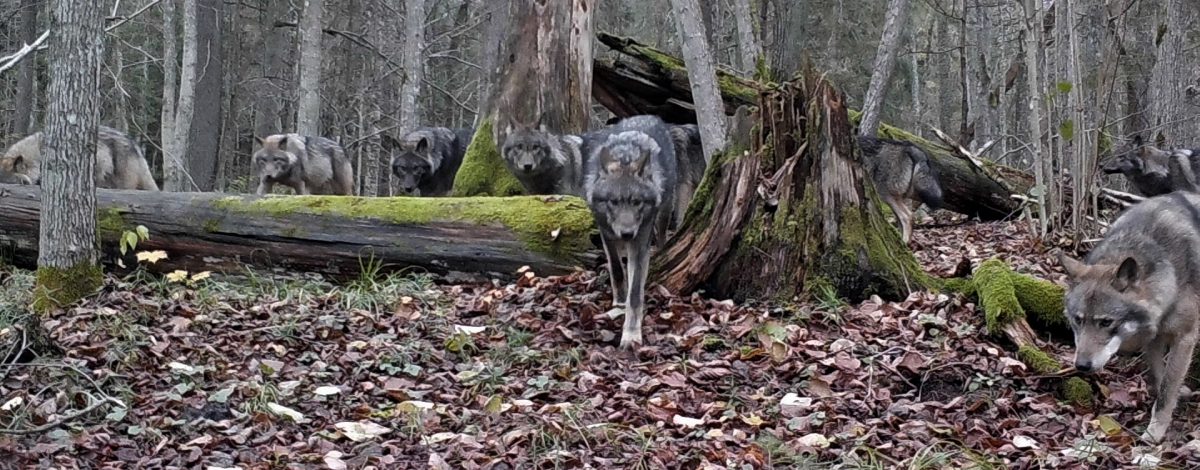
In the previous post on the topic, we considered all the ideas and respective material relating to the question. Actually, we consider the possibility that strong wolf packs could intimidate a mother brown bear, force her to abandon the hibernating den, and prey on her cubs. Given the substantial wolf population in Naliboki Forest, such events could occur several times each winter. In our opinion such a frequency of wolf aggression towards mother brown bears might be sufficient to halt the reproduction of the species within the forest.
Evolutionary Question
With respect to the above-described occasions, an interesting question may be raised. If wolves are able to stop reproduction in a bear population, how could these two carnivore species coexist for such a long evolutionary time?
Human Impact and Wolf Pack Dynamics
The possible answer connects with several stages of human impact on wildlife. First, forest exploitation, drainage, and agriculture led to a strong increase in the habitat’s carrying capacity for bison, elk, red deer, and lynx, species that are hostile to wolf breeding. Such facts of killing wolf pups by the above species we repeatedly reported in our books (Sidorovich and Rotenko, 2019, Sidorovich, 2022) and several posts of this scientific blog. In turn, when there are many of these species inimical to wolf reproduction, wolf pups hardly survive.
Second, when wolf pups survive normally, in winter wolf packs consist of wolf parents and their pups of this and previous biological years, as well as a few (one or two) other subordinate wolves. So, in a normal situation there are 2–4 adult wolves in a pack, and such a pack seems too weak to attack a hibernating bear.
In contrast, when only a few wolf pups survive, wolves, by aiming to kill a big prey like an elk, still create packs by subordinating roaming adult wolves. In such a situation there are 4–7, and sometimes even more, adult (i.e. strong) wolves in a pack. Such strong packs can attack hibernating bears, particularly smaller bear mothers with cubs. They scare the mothers away and kill the cubs.
Regions Where Bears Reproduce Successfully
Nevertheless, in Europe there are areas, even vast regions, where brown bears reproduce rather successfully. First of all the relevant example are the densely forested regions of European Russia, specifically Pskov, Tver, Vologda, Smolensk, and Novgorod. Even there such an examples in considerably smaller Belarus. They are, first, a densely forested region of north-eastern Belarus and, second, the forest massif around upper reaches of the Eastern Biarezina, where the Biarezinski biosphere reserve is situated. Each of these regions have own original story, how the local brown bear populations succeeded to escape from the pressure of wolves on their reproduction.
Case Studies: Russia and Belarus
Concerning to the forested regions of European Russia, in the 1990s and early 2000s, I, Vadim Sidorovich, spent extensive time in the Pskov, Tver, Vologda, Smolensk, and Novgorod. There I observed a near absence of wolves approximately 100 and more km from the Belarusian border. Wolf tracks on forest roads and riverbanks were sporadic, not daily. The effort required to find wolf footprints in Naliboki Forest in Belarus was disproportionately higher compared to those Russian regions, a stark contrast. The reason perhaps was that in those Russian regions, wild ungulate density was remarkably low, likely leaving wolves food-deprived and preventing them from establishing a dense population.
As to the forest massif around upper reaches of the Eastern Biarezina, in 1980s and 1990s the extraordinary heavy persecution of wolves by hunters was going on there at the reserve border. The relatively narrow and elongated reserve itself has quite poor-quality habitats for wild ungulates. Therefore, most of them stayed at the reserve border around agriculture fields. In turn, all the reserve wolves often visited the reserve surroundings, where they were killed by hunters. Quite opposite, brown bear having status of strongly protected species were not hunted and successfully bred without wolves.
Reverse Pressure: Bears Suppressing Wolves
It is more or less clear in our point of view. However, another interesting question arises. Returning in Naliboki Forest, we would like to mention that in this forest massif brown bears make a lot of damage for breeding in wolves by killing pups. For instance, in the late spring of 2025 in Naliboki Forest there were only three bears, and having so few bears, 3 out of 8 wolf litters suffered from those bears a lot. Also, before in 2020s we reported for several times about other brown bear attacks on wolf dens.
New Research Question and Next Steps
So, it could interesting to get know, is it possible for wolves to reproduce in such area as the forest massif around upper reaches of the Eastern Biarezina, which is densely populated by brown bears. There are more than 50 bears in the area of about 1000–1200 square kilometres. To study this question will be our next step in the study of reproductive struggle of brown bears and wolves in Belarus. Our preliminary data collected by camera-trapping and tracking in 2025 as well as similar and more extensive data gained by Aliaksandr Mysiew and Dzmitry Mysiew in 2023-2025 suggested that wolves cannot reproduce there anymore.
 Zoology by Vadim Sidorovich
Interesting I spent time in the Tver region from the mid to late 1990s, mainly in the Central Forest Reserve and the forest areas around Toropets. During that period, compared with what I’ve seen in Naliboki, I also noticed that wolf tracks were sporadic and usually made by single individuals. In spring there were very few signs of breeding activity. So I agree the low density of wild ungulates could be a major factor, we saw very little evidence of them either, whether sightings, tracks, or anything else.
LikeLike
Interesting I spent time in the Tver region from the mid to late 1990s, mainly in the Central Forest Reserve and the forest areas around Toropets. During that period, compared with what I’ve seen in Naliboki, I also noticed that wolf tracks were sporadic and usually made by single individuals. In spring there were very few signs of breeding activity. So I agree the low density of wild ungulates could be a major factor, we saw very little evidence of them either, whether sightings, tracks, or anything else.
LikeLike
Dear John, thanks for the essential comment supporting my idea, best regards, Vadim
LikeLike
Studying the interactions between bears, wolves and lynx is fascinating but challenging, as it depends on numerous factors that interact with one another; a fourth apex predator should be added to the mix: humans
LikeLike
Dear Jean-Claude, of course, you are right. Before we tried to take into account that indirectly, by combining different study areas with different rates of various human impact. It used to be like that. However, currently, when we live permanently in Naliboki Forest, we are able to act here mainly with a little expansion that you realised. The last autumn we did two months study on wolves and bears northwards of the Biarezinsky reserve, where you have been plenty of times. We used 12 to 20 camera-traps there, coming once per week in the area for the whole day starting 3AM and coming back Navust’ mid-night. Warm regards, Vadim
LikeLike