Co-authors: Louise Giovannelli and Irina Rotenko
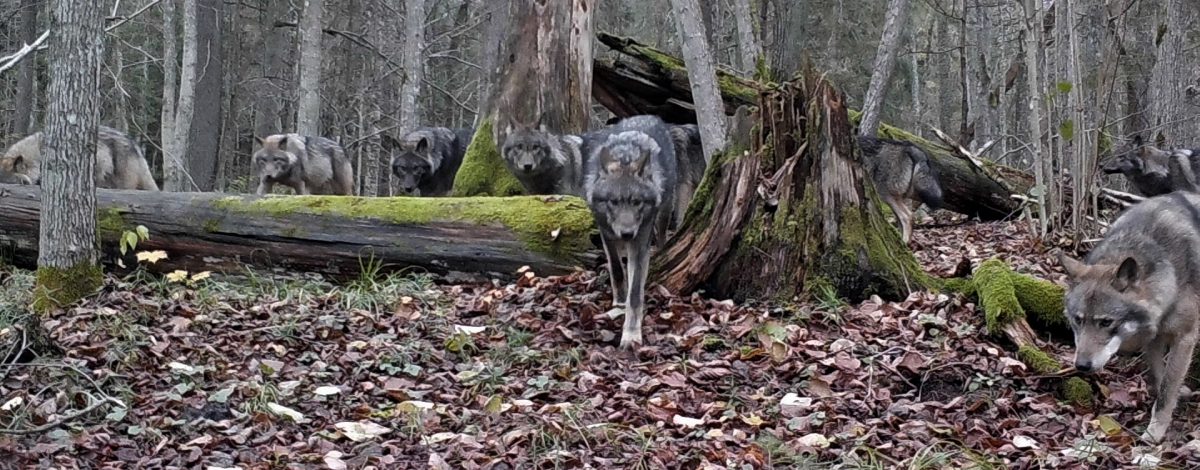
From mid-August to the end of October, we closely monitored the wolf families that had been registered as denning in Naliboki Forest (central-western Belarus) in late spring of this year. In addition to our spring findings, we discovered in early autumn that one breeding group had previously gone unnoticed. This group exhibited double-breeding behavior.
In the study area, which spans approximately 1,800 square kilometers, we recorded only 3 adult brown bears and 13–17 adult lynxes — significantly fewer than in the 2010s. The numbers of bison and other wild ungulates remained stable, except for a noticeable increase in red deer.
By early autumn, we documented 11 to 13 surviving wolf pups. The breakdown is as follows:
(1) Wolf breeding clan: This included one family with two simultaneously breeding females (double-breeding), two additional families with single litters, and a separate group of four non-breeding adults and subadults ranging between the families. In total, 7 to 9 pups survived. The area was inhabited by one adult female lynx with two kittens and one adult female bear. During the bear mating season, up to three bears were present, and at least two wolf pups were killed by bears.
(2) Newly discovered breeders: This group also exhibited double-breeding. Four to five pups survived. No bears were present. An adult male lynx, possibly aggressive toward denning wolves, was observed in the area.
(3) Single breeding pair: No pups survived. Two attacks by an adult male bear occurred during the first month of denning. Additionally, two adult male lynxes and a female with a kitten were present.
(4) Single breeding pair: No pups survived, likely due to persecution by hunters. A female bear and two adult lynxes (male and female) were present.
(5) Group of four adult wolves with two mothers (double-breeding): This group was not tracked in early autumn, but we confirmed the presence of at least a few pups.
We could not determine the initial number of pups in the dens due to difficulties in obtaining this information, caused by the unusually early denning observed in 2025.
By early October, we had identified approximately 15 wolf pups from 8 litters. These findings, along with the reproductive details of each breeding group, strongly suggest that pup survival was significantly higher due to the reduced presence of their primary predators — lynxes and bears.
 Zoology by Vadim Sidorovich
That’s a positive development. I hope that numbers will recover, including for the lynx, although that’s not really compatible, as the past has shown…
LikeLike
Your long-standing observations show that there is cross-predation between large predators, not to mention the destruction of young wolf cubs in their dens by wild ungulates. This clearly shows that human regulation of large predators is unnecessary when nature is allowed to take its course.
Jean-Claude Génot
LikeLike
Dear Jean-Claude, that is a very good thought, and I was convinced of it once such results were achieved. However, hunters like to kill large carnivores, and they will claim that they simply need to control the numbers of each species, while in fact violating the regulatory system that has been wisely organized by Nature.
Warm regards, Vadim
LikeLike