Co-author: Irina Rotenko
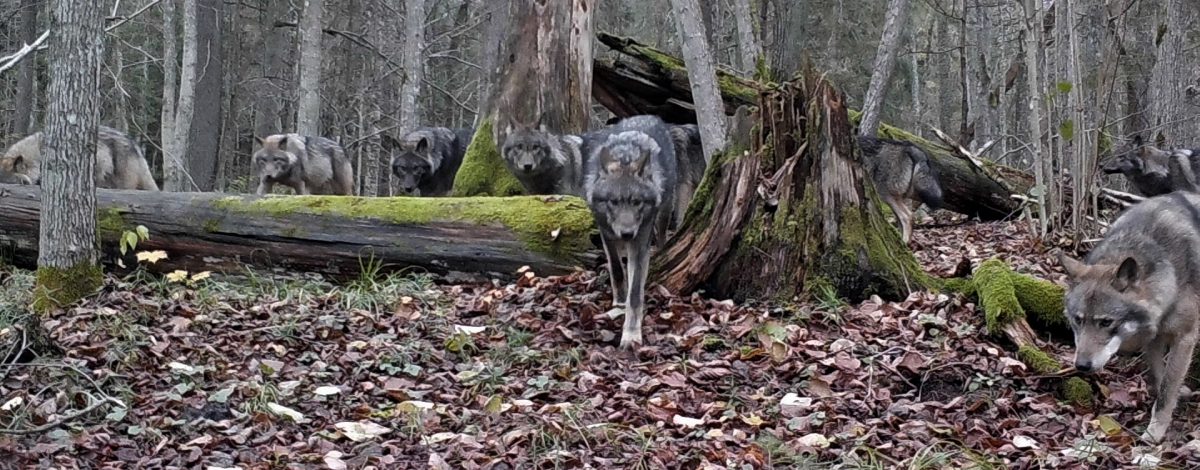
Over the last decades in Naliboki Forest (central-western Belarus), we have repeatedly documented multi-breeding wolf packs — most often double broods, occasionally triple broods. We now estimate that roughly two-thirds of wolf packs in this region reproduce in this intensive, multi-breeding strategy. This is likely driven by a combination of abundant prey and continued human persecution of wolves.
However, our latest fieldwork that was conducted from the mid-April through the late June 2025, has revealed an even more striking breeding strategy. Within an area of only about 140 km², we recorded three distinct wolf families (each with pups) living in exceptionally close proximity throughout the denning season. One of these families had two simultaneously breeding females (double-breeding), two of them had one litter each, while a separate group of four non-breeding adults and subadults lived there, ranging between the families. We define this newly observed social structure during breeding season as a breeding clan, a phenomenon that appears to be previously undescribed in wolf reproductive behavior. In contrast to multi-breeding within a single breeding group (let’s say a family), a breeding clan consists of several breeding families that act independently, while living in close proximity to each other; some of these families may also exhibit multi-breeding, with more than one breeding female.
This 140 km² area, where the wolf breeding clan stayed, included not only the denning places of the three families, but their hunting areas, too. Area of the denning places of all these wolf families occupied only about 70 km² of forest-swamp habitats. Distances between initial denning sites ranged from 1.9 to 4.2 km. By June the distances between these wolf families (i.e. parental wolves with pups) ranged from up to 6 km, narrowing at times to 3.9 km or even overlapping entirely, with separate breeding groups using the same sheltered habitat just days apart.
These wolves coexisted for three months with minimal signs of aggression. Otherwise, conflict would likely have driven some wolves to disperse. It’s plausible that most individuals were related or in peaceful subordination. Actually, we did not find any interference between them. Even their territorial marking was rarely registered.
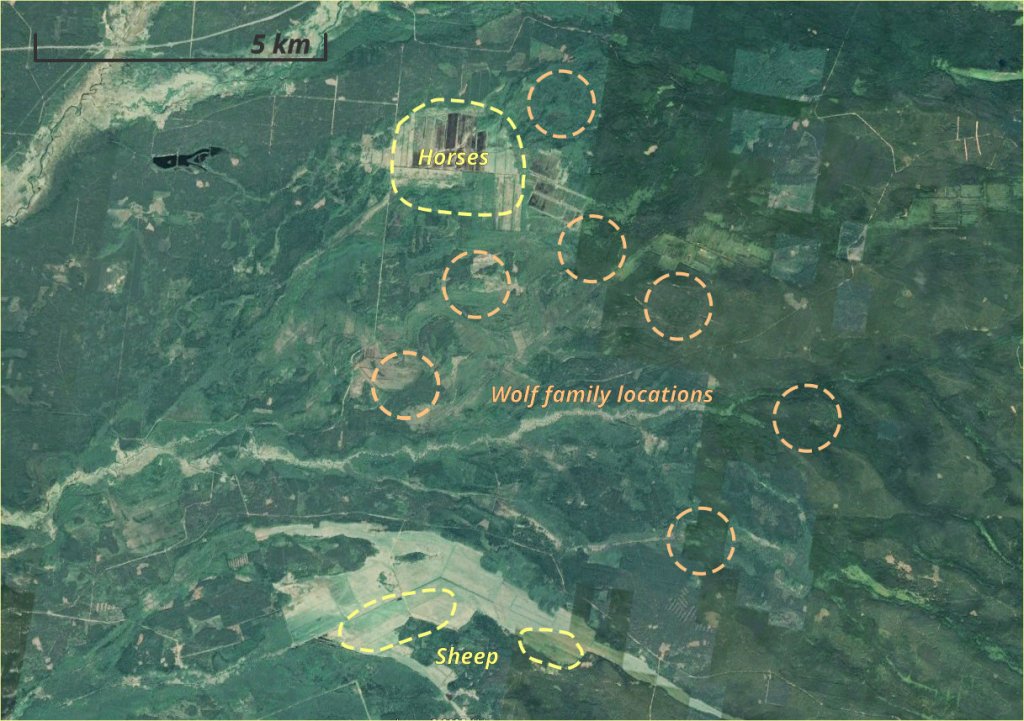
We hypothesize that this exceptionally cooperative and intensive breeding behavior is underpinned by an unprecedented surplus supply with prey. The area has long been rich in red deer, roe deer, beaver and wild boar. But in recent years, a massive surplus of easily accessible prey (specifically around 300 tarpan-like horses and at least 800 sheep) has transformed the local foraging area. Wolves now take this prey with ease.
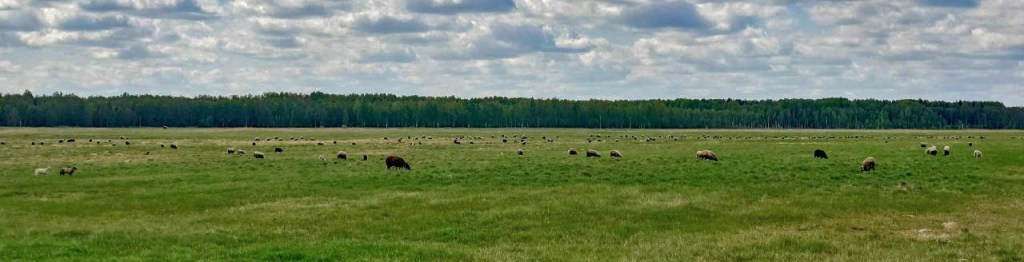

This shift has drastically altered the wolves’ diet during the denning season. Previously, parental wolves primarily relied on beavers and roe deer, along with calves of red deer and elk, and wild boar piglets. Currently, over 90% of prey occurrences in wolf scats from this denning area consist of horse and sheep remains.
 Zoology by Vadim Sidorovich
Interesting developments again. I remember that a few years ago, the wolves seemed to avoid the horses, but that has now completely changed. So the group of 150 horses has now doubled in size?
Do the wolves mainly hunt foals and yearlings, or do they also go for the adults? The older adults are not that old yet, as they only arrived in 2019. The main herd seems to have remained loyal to their grazing grounds since their arrival, with the wolves staying on the outside of the grazing area. This seems a good strategy to protect the pups from being trampled, while still keeping their prey within reach.
However, these large prey will also cause (or have caused) many injuries to the wolves in the early years, as hunting a herd requires adaptation of hunting techniques. Perhaps it was a collaboration between related family groups hunting together? Or do you see a clear separation during the hunt between the various breeding families and the adult group? You would almost expect there to be family ties.
But since when have there been such large numbers of sheep? I can’t remember seeing any sheep in these fields.
In any case, it doesn’t make it boring. But that’s never the case in Naliboki 😉 An added bonus of so many horses on the road is that you can pick up some manure for the kitchen garden…
Greetz, Gerard
LikeLike
Dear Gerard, thanks for the comment. I am not in good knowledge to answer on all your question correctly. We are only going to investigate all these suddenly appeared questions. Really before wolves were reluctant to prey the horses as a new strange prey that is widely known in the world for such a situation. They only scavenged on horse carcasses. Nowadays, they gather foals and kill weakened individuals even big ones. We observed as wolves for an hour roamed between the horses searching for suitable situation to take young horse. Therefore, the horse population grow so slow, and in autumn there are surprisingly few young horses between adults. As to sheep, they appeared quite suddenly. Perhaps, the local farmers found the way how to earn with raising of sheep. But it is so expensive to provide a good guarding of sheep in Naliboki Forest. So, the farmers hope that the sheep reproducing will prevail on taking them by wolves. Even perhaps just I made sure of one of the farmers that there would not be so many wolves to damage his sheep dramatically due to wolves are strictly territorial and have large territory particularly in breeding season. Now with that wolf breeding clan that we have found I see that I made mistake. Poor farmer. Warm regards, Vadim
LikeLike
Very fascinating findings. However, it reminds me of some descriptions of wolves in Yellowstone National Park, USA. I previously read a nonfiction book by naturalist Rick McIntyre titled Thinking Like a Wolf: Lessons From the Yellowstone Packs. One of the packs mentioned, the Junction Butte Pack, experienced tensions among its females after the death of the former alpha female, 970F. From what I recall, three females (969F, 907F, and 1382F) at one point split into two denning groups—two shared a den while the third denned separately. Meanwhile, another female, 1109F, who was often excluded by the others, would den farther away, though she occasionally received help from certain male in the pack. The book also seemed to mention that conflicts between female wolves decreased after giving birth. Personally, I suspect this may be related to seasonal hormonal changes and the fact that wolves devote more energy to pup-rearing during this period.
Since I last read the book a year ago, I’m not entirely sure if my memory is accurate. But if I remember correctly, I’m very curious about how the ‘breeding clans’ you described differ from the ‘multi-breeding’ phenomenon observed in places like Yellowstone. If possible, I’d love to see a more detailed discussion of these wolf family structures in the future, as well as a comparative analysis of multi-breeding behaviors between Naliboki’s wolves and those in other regions (such as Yellowstone).
Thanks
Guo
LikeLike
I don’t think you should ever want to compare Yellowstone NP wolves with those in Naliboki. The conditions and pack structure are completely different. You mention the Junction Pack, for example, which once had as many as 35 members. That will never happen in Naliboki. Don’t forget that Vadim has been studying wolves for almost 10 years longer than the entire wolf project in YNP has now been running.
Of course, breeding behavior in different wolf populations can be compared. But let’s be careful not to relate every wolf study to Yellowstone. I think that would compromise new insights and observations.
Although they are the same Canis Lupus, you could almost speak of two different subspecies if you compared the populations side by side, at least that’s my opinion.
LikeLike
That’s make sense. That’s exactly why I’d really like to see Mr. Sidorovich, if possible, show a detailed comparison of multiple breeding behaviors between Naliboki and Yellowstone wolves. This would greatly help us better understand these new insights and discoveries about wolves.
LikeLike
Dear Guo, thanks for your interesting message and important question raised. I should pay attention myself on such a distinction. Now it is already corrected in the post. I changed like that: We define this newly observed social structure during breeding season as a breeding clan, a phenomenon that appears to be previously undescribed in wolf reproductive behavior. In contrast to multi-breeding within a single breeding group (let’s say a family), a breeding clan consists of several breeding families that act independently, while living in close proximity to each other; some of these families may also exhibit multi-breeding, with more than one breeding female.
Thanks one more time, Vadim
LikeLike
dear vadim
Who belongs the sheep ? Private owner lining in Naliboki forest? And same question for the tarpan ?
LikeLike
Dear Jean-Claude, the sheep belong to the two private owners. tarpan-like horses belong to the Naliboki reserve.
All the best, Vadim
LikeLike
dear vadim
If wolves kill tarpans horses, what would be the position of the managers of Naliboki reserve?
Jean-Claude
LikeLike