Co-authors: Louise Giovannelli and Irina Rotenko
Throughout April and May 2025, we conducted a study on wolf breeding within the Naliboki Forest (the central-western region of Belarus), covering an area of approximately 1,800 square kilometers.
We identified six breeding groups and located eight litters. Of these groups, four consisted of a single pair, while two comprised two breeding females each. Notably, one of the latter groups was composed of an adult male and two breeding females, and the other additionally included a yearling.
During the spring of 2025, out of the eight registered parturition events, five occurred earlier than usual (one at the beginning of April, three in March, and one possibly in the latter half of February). This high frequency of early breeding can no longer be attributed solely to stray dog hybridization, especially as no such hybridization has been detected over the past three years. We hypothesize that the unusually warm winter of 2024-2025, characterized by absence of snowfall and greatly higher temperatures (particularly during the early winter months), has prompted considerably earlier mating in wolves.
The primary denning habitats were mainly pine stands on sand dunes, which allowed wolf parents to minimize disturbances at their dens from potentially threatening animals such as bison, lynx, brown bears, stags and elk. One den, active for several days, was observed in a broadleaved deciduous oldgrowth forest in a river valley, while another was located in a clearcut area undergoing early reforestation. However, the den in the clearcut area was extirpated by a brown bear.


An additional den (the ninth denning) involved a wolf female paired with a male golden jackal. It was found in a recently drained area within the Naliboki Forest, and parturition in this hybrid pair occurred approximately at the end of March.


The photos illustrate the denning area associated with the wolf and golden jackal. They also show scats and a hind footprint (while running) of the male golden jackal.

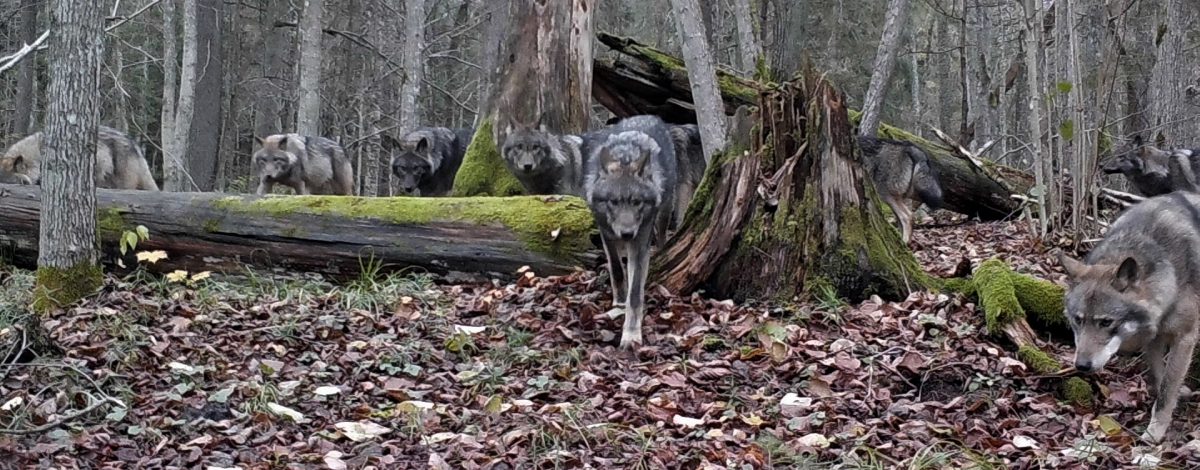
The wolf pups, which were born in the late February, resting in grooming spot on 2nd July.
 Zoology by Vadim Sidorovich
That would be very interesting if the investigation reveals hybridisation with the golden jackal… only four and a half years after you first found traces of the species, Vadim.
Warm regards, Gerard
LikeLike
Thanks a lot for the comments. Interesting and important that you have noticed that, too. I will keep you informed re possible hybridization. It is so pity that we found the den several days after the family left the place. Warm regards, Vadim
LikeLike
I saw in the web that cross breeding between jackal and wolf is possible and the young are fertile ; they are called huskal
JC Génot
LikeLike