Co-author Irina Rotenko
In Naliboki Forest, a central-western region of Belarus, a dense population of wolves has long existed. In the past decade, brown bears have expanded into this forested area, raising a pressing question: how do these two large predator species interact? Particularly: the aggressive interference of wolves and brown bears, and how their individual characteristics affect the encounter, is important to investigate.
In Europe, apart from the known observations of brown bears and wolves at man-made feeding stations and some rough theoretical thinking, we would like to say that there is actually a lack of documentation on the interspecific interactions between wolves and brown bears. Therefore, we cannot claim that this question is well-studied, and that the species interactions are well-known and easily predictable.
There are many reports of such behavioural interactions of wolves and bears in North America, but they may not reflect what happens between the species in Europe. These bears and wolves in North America and Eurasia are still erroneously classified as the same species, but they are actually very different in their behaviour, ecology and origin. Moreover, their populations in North America and Eurasia have been isolated for a long time by living in very different environments.
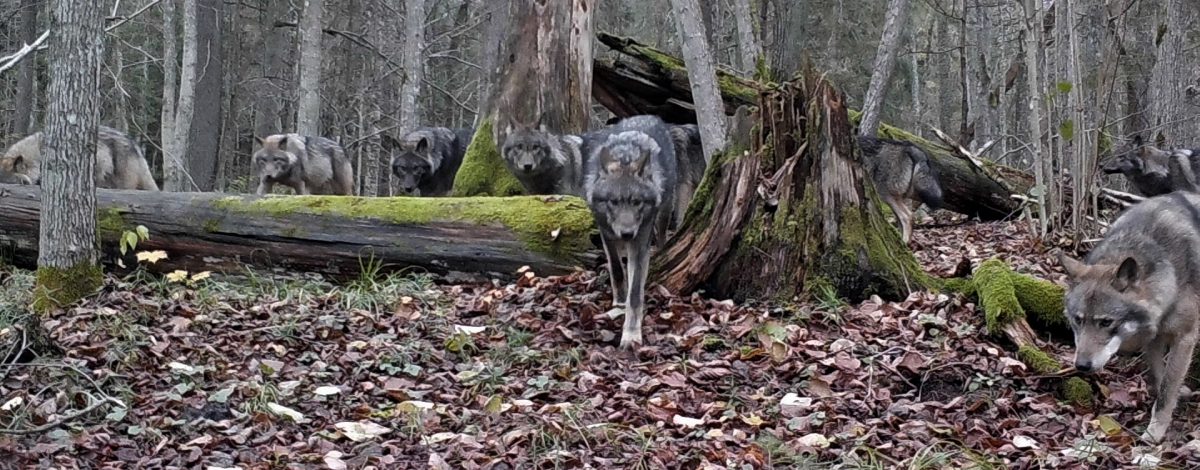
Recently, we managed to film a footage of a brown bear being chased by two parental wolves from the place where their pups stayed. You can see the footage below.
In the footage, you can see the parent wolves and their pups in the home area of the wolf family. The wolf family had five pups that mostly stayed in an area of about one square kilometre. The footage also shows that the parent wolves were regularly bringing meat in their stomachs for the pups. One day, a brown bear appeared near the pups in the wolf family’s area. The parent wolves soon detected it by smelling its tracks. Then you can see the bear being chased by the parent wolves away from the pup location. The footage spot was about 460 metres away from where the pups were. Interestingly, there was a lot of struggle between the bear and the wolves 30 metres before and 20 metres after the footage spot, as indicated by the trampled forest floor and some tufts of hair from both species.
Two years ago, we documented several aggressive encounters between wolves and bears in Naliboki Forest. In one case, a pack of five adult wolves attacked a bear that was sleeping in its open hibernation site. The bear was medium-sized compared to other bears in Belarus. The bear defended itself under a spruce tree, snuggling to its trunk with its back, and then ran away in one direction. Later we learned that the bear ran to a young spruce thicket with many fallen birches. The bear tried to run through the densest vegetation possible (willow bushes, reed, young spruces, fallen trees etc.). The wolves were mostly running beside the bear. Before the bear reached the thicket, the wolves stopped it seven times. Each time, it was in a small clearing or a spot with few trees and bushes. The bear fought back in each spot, snuggling to the nearest big tree or large willow bush, and then continued running. Finally, after running about 3 km together, the bear reached a small spot of young spruce thicket with two fallen big birches. It seemed that the bear injured one wolf there inside the thicket. There was not much blood, so we think that the bear tore off a piece of skin from the wolf’s back. After the encounter in the small thicket, the bear moved to a larger one nearby. The wolves stopped attacking the bear and left.
Interestingly, in the previous winter, a pack of seven adult wolves had a home area (where they often stayed) where a big brown bear hibernated in a large self-made burrow at first and then in an open nest. The wolves did not bother the bear and always kept about 100 metres away from it while passing by its hibernation site.
In another case, a brown bear found a wolf den and started destroying it. It took half an hour for the bear to extirpate it. It looked like the parent wolves were watching the bear’s action from a distance, but they were too scared to approach and attack it. Right after the bear left, the parent wolves came to the ruined den. They looked frightened. They inspected the den site cautiously and timidly, and then left and only came back at night. They also returned to the den site for a few more nights, trying to dig and investigate the burrow den inside and looking for their pups. It is possible that some of the pups were killed and maybe eaten by the bear. It is worth noting that the bear was medium-sized, and the father wolf was rather big.
To summarize our current findings on the interspecific interactions of wolves and brown bears in Naliboki Forest, we would like to suggest that the size of both species and the number of wolves involved in an encounter are important factors that may influence the outcome. However, this is only a theoretical assumption, as we did not observe any clear patterns based on the limited data we collected. Perhaps, with more data on this topic, we will be able to identify some regularities. We also think that the experience of both bears and wolves in interference with each other is a crucial factor that may determine who will dominate in such an encounter.
 Zoology by Vadim Sidorovich
Thanks to your hard work this is one again great information and a wonderful video , this blog really is an education , thank you for sharing as I miss Naliboki very much and dream of my return , I wish you all the best Vadim and Ira
LikeLike
Thanks, John.
LikeLike
Wonderful footage. And thanks for the interesting reflection on the confrontations observed so far.
Warm greetings,
Gerard
LikeLike
Dear Vadim,Wh
LikeLike
Dear Michael, sorry your comment is partially missing. Would you mind writing it again?
LikeLike
Dear Vadim, my question was, what do you think. how degree of hybridization matters in cases of multi-breeding in wolf packs. Best wishes Michael
LikeLike
Dear Michael, thanks for the interesting question, you raised. According to Stronen et al., 2013, in Belarus in the early 2000s none of the genetically investigated wolves showed dog ancestry, while a pack multibreeding in wolves in the country was found since the early 2000s (Sidorovich and Rotenko, 2019). The more we worked on the question of multibreeding in a wolf pack, the higher portion of the investigated packs was proved for multibreeding. I think it is experience-related, but maybe not only. For instance, the last spring and summer in Naliboki Forest we found and documented two situations of pack double-breeding and triple-breeding in one case. Single breeding in two cases was revealed too. Two wolf litters were born very early (the late February-mid March). The last new phenomenon we connect with wolf and dog hybridization. It is going on, but still not widely spread, approximately already hybrids or stray dogs take part in one out of 10 to 20 breedings in wolves. Who knows, maybe this hybridization leads to increasing in the phenomenon of pack multibreeding. Hard to say, still. Best regards, Vadim
LikeLike
I wonder f it is not the size of the bear, what determines wolf’s attacks then: protecting their young, hunger? Video is great, real nature as it is
LikeLike
Thanks. I think it was just protecting of their pups, which were situated about 460 metres from the point of the camera-trap.
LikeLike
Good job! Great video! Is it true that the wolf dens are always situated near the river or some bigger source of water? How far from the water source is the place when the mother wolf breeds his pups? I suggest that water source must be very close, because she needs to drink often and a lot when she is going to breed. How is the reality dear Vadim? Thanks for answer. Your fan.
LikeLike
Dear Milan, thanks for the question. In my quite large experience in Belarus (86 actual dens with pups were found and more than one thousand recent dens were found; parental wolves change their den often) it is almost not a consistent pattern. Here in Belarus finding of water to drink by wolves is so easy, because forever there is something nearby, where it is possible to drink. It may be a small stream, river, drainage or other type canal, pool, lake, pond, swamp with some water. Only in sand dune massif wolves definitely den nearby a water source. The same rule is attributable for any age pups during quite long-lasting drought.
LikeLike
I have two camera-traps in Slovakia- Zapadne Tatry hidden in places where some wolves stay (according to excrements and footprints, and even chewed PET bottle and some bones) but never cought a wolf. Only bears, badgers and foxes from carnivores. I know it is hard to catch a wolf on camera-trap.
LikeLike
Detailed knowledge of how a particular wolf pack uses their terrain is crucially important to catch a wolf on a camera-trap. Also, an invisible flash camera-trap should be only applied in the wolf case.
LikeLike
Thanks for answer! Just one more question. I know the place where I often find excrements and footprints. In that places I even found chewed PET bottle and 2 about 40-cm long bones which I supposed it was for them to play. Distance from PET bottle and bones is only about 10 meters. It is in young spruce thicket. Do you think that they will often return to that place, or it was just an accident that wolves were there?
LikeLike
Vadim will probably also respond to this question and give his views. But here my experience:
The PET bottle an the bones were probably toys for the puppies. It looks like you have found one of the rendezvous spots. The wolf packs I monitor relocate several times to another rendezvous spot where they then stay again for a while.
If the wolves were using the spot at the time you found it and have realised you were there, they will almost certainly leave the spot and not return. If it was a previously used rendezvous spot, then they had already left and then usually do not return.
LikeLike
It looks like wolves (possibly parents with pups or maybe subadults) were there, but it does not mean that they will come back one day.
LikeLike