Co-author Irina Rotenko
High mortality in wolf pups is a well‑known demographic bottleneck that strongly shapes wolf populations worldwide. Belarus is no exception: as documented in Sidorovich & Rotenko (2019) and in several posts on this blog, pup mortality here is particularly severe. In Belarus survival of wolf pups to the first winter is a crucial stage in the species population dynamics.
Recently, North American researchers reported that wolf pup survival was negatively related to litter size (Hynes et al., 2026). Although we have accumulated extensive material on wolf reproduction in Belarus (96 litters were more or less detailed monitored from denning to the first winter) we had never formally tested this relationship. In this post, we examine whether initial litter size is related to the number of pups surviving to the first winter and to the survival rate itself.
Our study was conducted in two large forest massifs: Paazierre Forest (northern Belarus) and Naliboki Forest (north‑western Belarus). In both areas, our research covered approximately 1500–2000 km². We used three datasets:
1. Paazierre Forest (mainly 1997–2004)
A densely forested area lacking red deer and bison. Lynx were scarce (0.4–3.1, mean ~1 individual per 100 km²), and brown bears were also uncommon (0.5–4.2, mean ~2 individuals per 100 km²). These four species – red deer, bison, lynx, and brown bear – are important to consider because they influence wolf reproduction by killing pups.
Litter size at the den was determined by deliberate searches in late spring. The number of pups surviving to winter became known when hunters killed entire packs.
2. Naliboki Forest (mainly 2016–2024)
A densely forested area with abundant red deer and 80–120 bison. Lynx were common (2.2–5.1, mean ~4 individuals per 100 km²), while brown bears were present at low density (0.5–1 individual per 100 km²). Again, these species represent important pressures on wolf reproduction.
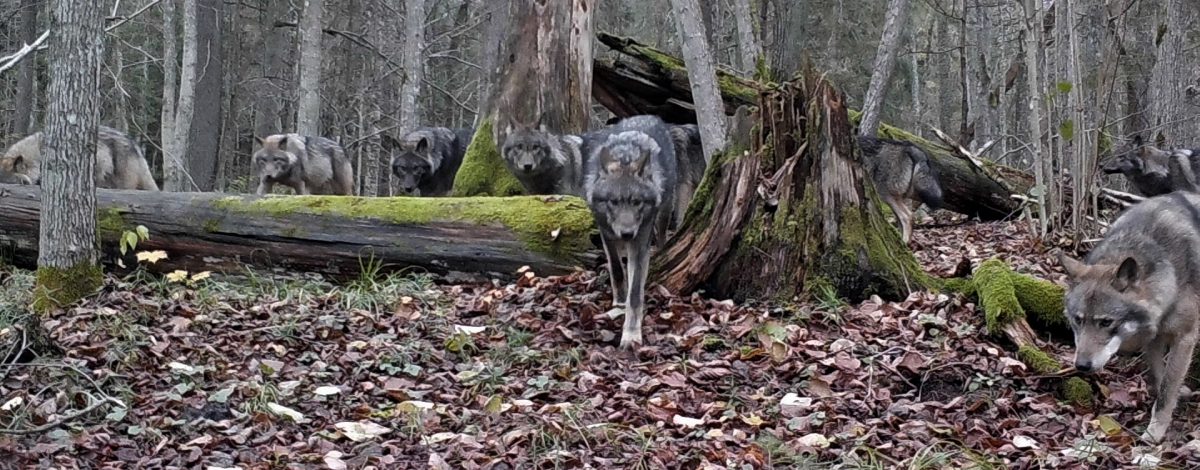
Here, litter size was determined both by deliberate den searches in late spring and by camera‑trapping at pup playgrounds in mid‑summer. Winter pup numbers were obtained either from camera‑trapping or from hunter‑killed packs. Thus, for Naliboki Forest we had two independent datasets: one starting from den counts and one starting from mid‑summer playground counts.
Results
Paazierre Forest
Wolf pup survival to the first winter was high (57%) but stochastic. There was:
- no correlation between initial litter size and the number of pups surviving to winter
- a strong negative Spearman correlation between initial litter size and survival rate
This suggests that parents with smaller litters may provide more care per pup, increasing individual survival probability.
Naliboki Forest: starting from den counts
In this forest massif, which was full of hostile animals for wolf breeding and where many wolf litters were killed (see numerical posts of this blog), early pup mortality was extremely high. Survival from denning to the first winter averaged 25%.
We found:
- a strong negative Spearman correlation between initial litter size and survival rate
- a weak negative correlation between initial litter size and number of pups surviving to winter
Naliboki Forest: starting from mid‑summer playground counts
Here, the pattern reversed.
We found:
- a statistically significant positive Spearman correlation between mid‑summer litter size and number of pups surviving to winter
- no correlation between mid‑summer litter size and survival rate
This indicates that the denning period (mid‑April to early June) and the first half of summer are the most critical phases for pup survival.

Raw Data
Below we list the initial datasets used in this analysis.
Paazierre Forest (starting from den counts till the first winter)
- 7 → 5
- 7 → 1
- 2 → 2
- 4 → 3
- 9 → 0
- 3 → 3
- 9 → 4
- 6 → 4
- 10 → 3
- 4 → 4
- 9 → 4
- 3 → 2
- 8 → 2
Naliboki Forest (starting from den counts till the first winter)
- 5 → 3
- 11 → 2
- 6 → 0
- 7 → 0
- 6 → 0
- 4 → 0
- 3 → 2
- 9 → 0
- 6 → 2
- 7 → 0
- 7 → 1
- 2 → 2
- 10 → 0
- 1 → 1
- 5 → 3
- 9 → 0
- 11 → 2
- 4 → 2
- 7 → 0
- 5 → 0
- 4 → 0
Naliboki Forest (starting from counts at playgrounds in the mid-summer till the first winter)
- 9 → 5
- 3 → 1
- 4 → 0
- 2 → 2
- 5 → 0
- 5 → 1
- 6 → 5
- 4 → 0
- 3 → 0
- 4 → 2
- 5 → 0
- 2 → 0
- 3 → 3
- 6 → 0
 Zoology by Vadim Sidorovich