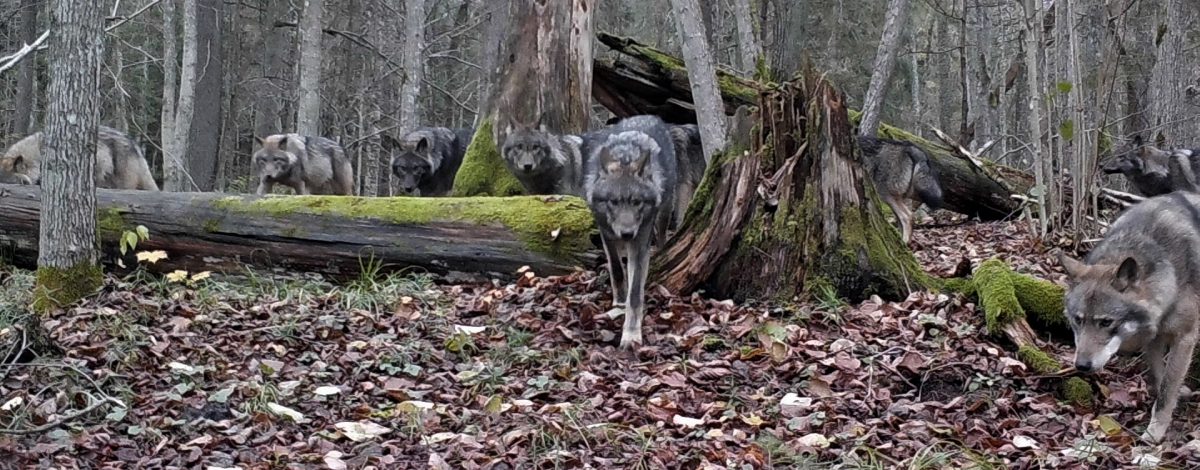
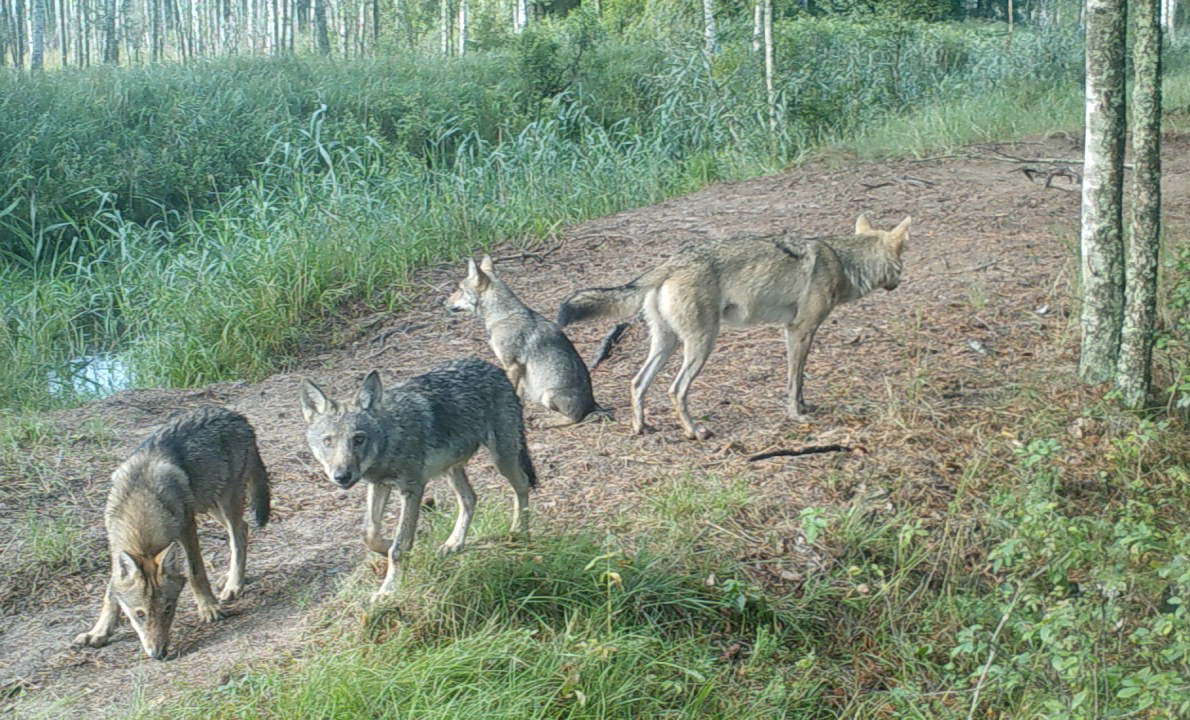
In Naliboki Forest in May-June 2025 within an area of only about 140 km², we recorded three distinct wolf families (each with pups) living in exceptionally close proximity throughout the denning season. One of these families had two simultaneously breeding females (double-breeding), two of them had one litter each, while a separate group of four non-breeding adults and subadults lived there, ranging between the families. We define this newly observed social structure during breeding season as a breeding clan.
Continue reading “Some findings on the development of a wolf reproduction clan”Tag: behaviour
Again, higher survival of wolf pups in the conditions of lower numbers of lynxes and brown bears in summer 2025
Co-authors: Louise Giovannelli and Irina Rotenko
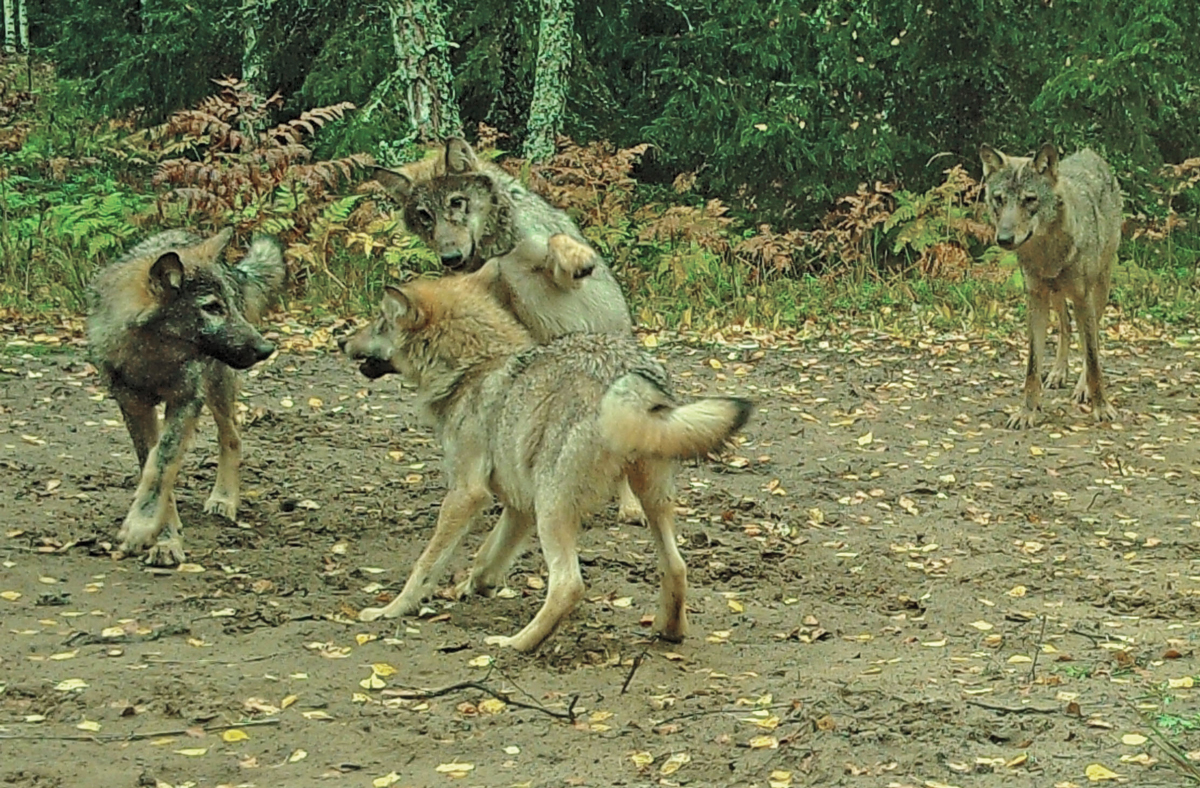
From mid-August to the end of October, we closely monitored the wolf families that had been registered as denning in Naliboki Forest (central-western Belarus) in late spring of this year. In addition to our spring findings, we discovered in early autumn that one breeding group had previously gone unnoticed. This group exhibited double-breeding behavior.
Continue reading “Again, higher survival of wolf pups in the conditions of lower numbers of lynxes and brown bears in summer 2025”Wolf breeding clan under conditions of surplus prey abundance in Naliboki Forest: a new phenomenon
Co-author: Irina Rotenko
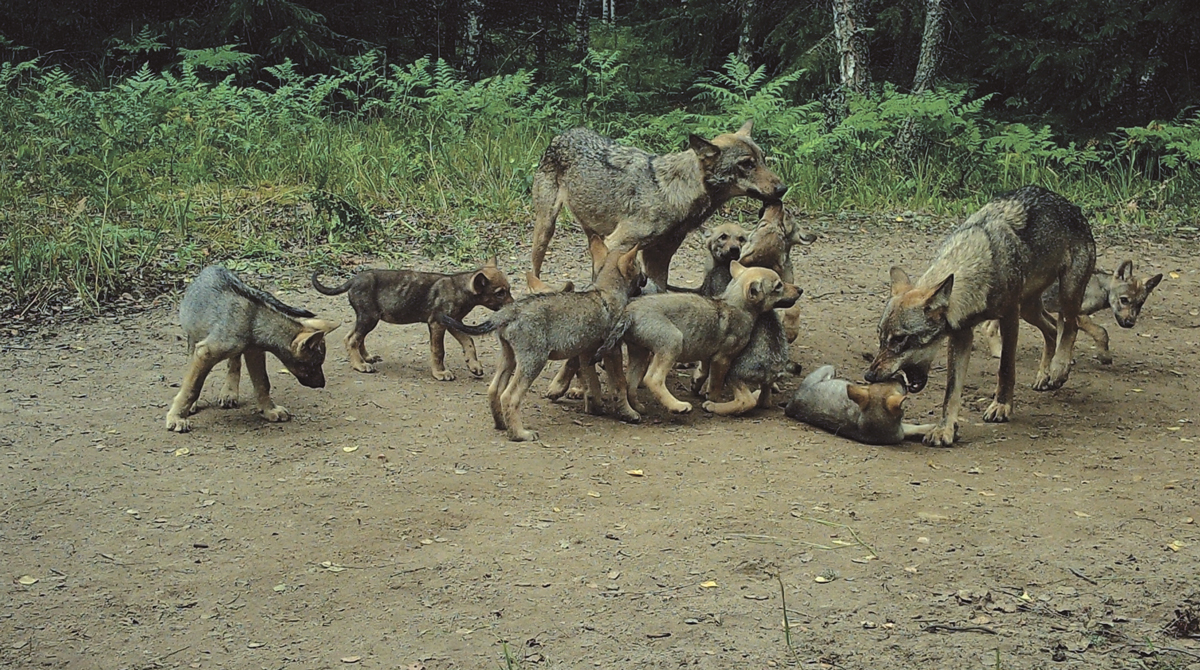
Over the last decades in Naliboki Forest (central-western Belarus), we have repeatedly documented multi-breeding wolf packs — most often double broods, occasionally triple broods. We now estimate that roughly two-thirds of wolf packs in this region reproduce in this intensive, multi-breeding strategy. This is likely driven by a combination of abundant prey and continued human persecution of wolves.
Continue reading “Wolf breeding clan under conditions of surplus prey abundance in Naliboki Forest: a new phenomenon”Study on wolf reproduction in Naliboki Forest in 2023: a short report

Co-author Irina Rotenko
During 2023, we continued our long-term studies on the wolf reproduction in Naliboki Forest (see Sidorovich and Rotenko, 2019 and other posts in this blog for details and more information). An outstanding feature of this year for the reproduction of wolves in Naliboki Forest was the relatively low number of lynxes (15-20 individuals). This is 4-5 times lower than that in 2016-2018. Lynx is one of the hostile species for wolf pups (Sidorovich and Rotenko, 2019; Sidorovich, 2022), and presumably killing of wolf pups by lynxes can nullify the breeding efforts of wolves. However, there are other hostile animals to wolf reproduction such as brown bear, bison, elk and red deer, sometimes wild boar and even red fox (Sidorovich and Rotenko, 2019; Sidorovich, 2022). Therefore, we still could not test the hypothesis of which of these antagonistic species plays the main role in killing of wolf pups. This year gave us a unique opportunity to examine the role of lynxes.
Continue reading “Study on wolf reproduction in Naliboki Forest in 2023: a short report”Video-documentation of stay of lynx kittens, when their mother went for hunting

Co-author Irina Rotenko
Mother lynx left her kittens in a sheltered place at a small beaver pond surrounded by reed thicket and went for hunting. After half an hour play, the kittens went to rest in the reed stand. Three hours later lynx mother reunited with them.
Continue reading “Video-documentation of stay of lynx kittens, when their mother went for hunting”Enigmatic warm-season behavior and ecology in Eurasian lynxes: pressing questions, hypotheses and results up-to-date

The behavior and ecology of the Eurasian lynx during the snowless season, particularly from the second half of April till the end of October (hereafter the warm season), is still searchless, and several important questions of study on the species in this seasonal period are seemingly even unknown. The main hassle is that the prevailing research method of GSM GPS telemetry fails to investigate those questions. Basically this method only records coordinates and how active or passive the individual is. It looks like currently the single possible way to learn about the behavior and ecology during the warm season goes through much routine habitat inspection, art skills to read activity signs of lynxes in snowless period and smart extensive camera-trapping.
Continue reading “Enigmatic warm-season behavior and ecology in Eurasian lynxes: pressing questions, hypotheses and results up-to-date”Why do brown bears act so much at tar-treated power poles (Barsucha steading, Naliboki Forest, Belarus)?

In Naliboki Forest (north-western Belarus)there is Barsucha steading that was abandoned by locals seven years ago. For the last five years a male brown bear has been living here. There are about thirty power poles that brought electricity to the steading. The power poles were made from pine logs and deeply treated with tar (particularly by creosote). At least, 22 of these poles were regularly visited by the bear. The bear acted there by gnawing the poles and rubbing against them by different ways. Additionally the bear dug for the tar around the pole and rolled a lot on at the poles.
The variety of life styles of Eurasian lynxes in Belarus

In Eurasian lynxes there are several age-sex categories, which are strikingly or markedly differed by their life styles. The data that leads us (Naust Eco Station & Wild Naliboki) to this conclusion originated from about 2300 km of snowtracking lynxes, multiannual study of lynxes with camera-traps (up to 70) and much other various research results. Among them the results of two lynx telemetry projects.
Continue reading “The variety of life styles of Eurasian lynxes in Belarus”
Enigma of lynx pee

During quite a lot of studies on the Eurasian lynx in Naliboki Forest and Paazierre Forest we realized that this species is still so poorly known (Sidorovich et al., 2019). Even a simple lynx pee hides several non-studied questions that were raised during investigation the species behavior. Several curious pee-related phenomena were registered that was already some achievement, but for every one still there is a pressing question how such a pee regime is possible on a morph-physiological level i.e. by means of which morph-physiological adaptations of the species. Maybe somebody, after reading the post, will try to investigate the lynx pee questions.
Continue reading “Enigma of lynx pee”
Great interest in marking by lynxes from other mammals

Co-author Irina Rotenko
Concerning territorial marking by lynxes there is intriguing question of a great interest of wolves, red foxes and deer to lynx marking points, but there is no such a reaction of lynxes and deer to marking by wolves. It is easy to realize, why red deer, roe deer and red foxes pay so much attention – lynxes kill them often. Therefore, any information about lynx distribution and status (adult or young, sex, welfare etc.) are important for these victim species. The same is for wolves. Adult lynxes not infrequently kill wolves from vulnerable categories such as pups, heavily pregnant females, just small individuals. However why there is no such a pronounced reaction on marking by wolves?
Continue reading “Great interest in marking by lynxes from other mammals”
 Zoology by Vadim Sidorovich