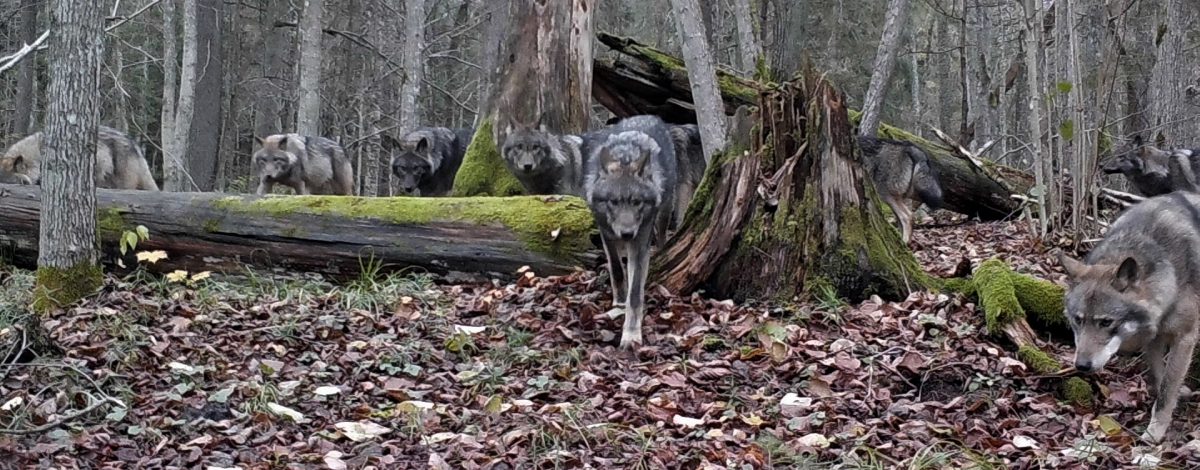

In the scientific literature about brown bears Ursus arctos and wolves Canis lupus there is information on the interactions of the species. Nevertheless, facing that denning in wolves is so insufficiently investigated (Sidorovich and Rotenko, 2017, 2019), it is easily believed that possible interference of brown bears towards wolves at denning is unknown still.
Continue reading “Question of interspecific interactions of brown bears and wolves”Category: Current studies
The next step in the change of wolf denning habitats in connection with further increase in red deer and bison numbers in Naliboki Forest
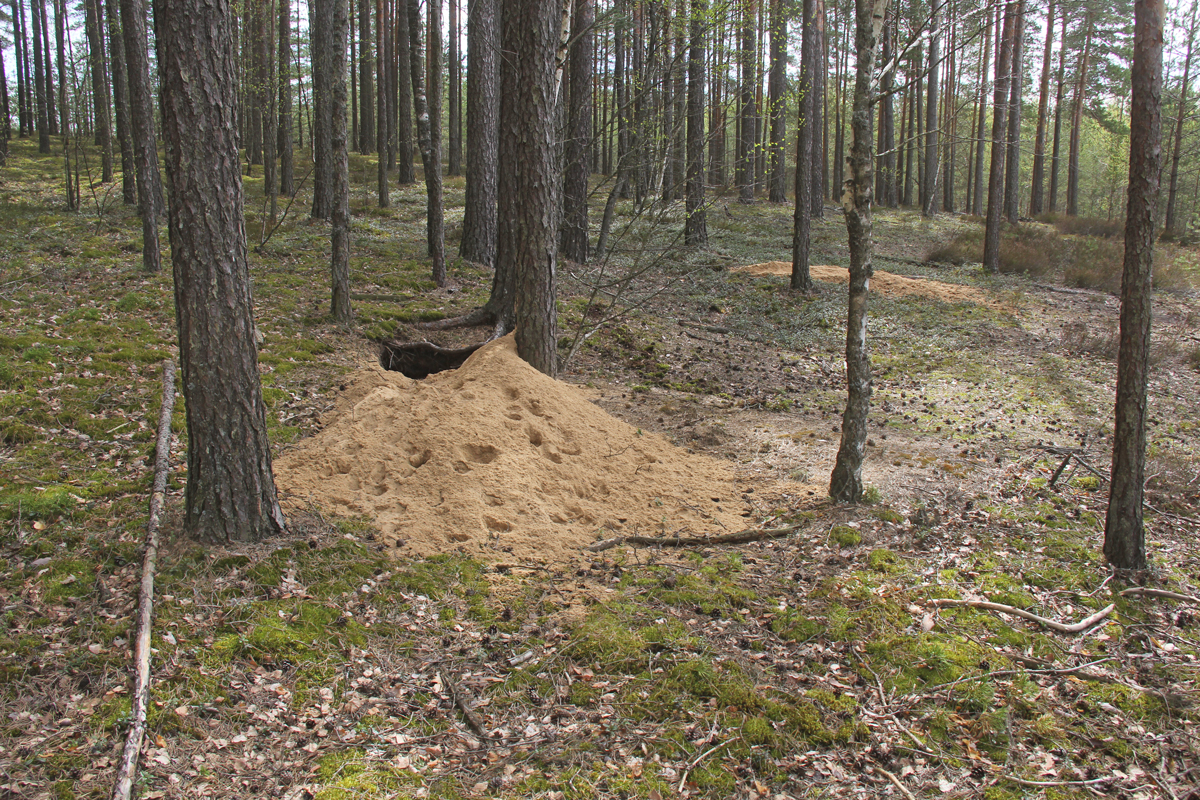
In June of 2018 there was post “Trends in the denning behaviour of the wolf and lynx in connection with the changes in the vertebrate community in Naliboki Forest (north-western Belarus)”, in which I described the changes in the denning behaviour of wolves and lynxes in connection with the population growth of the lynx, red deer, bison, and recovering of the badger population in the 2010s. It was shown that wolves with their prevailing of an open denning appeared in the hard situation to reproduce despite of the extra breeding efforts, first of all, with a pack multi-breeding.
Continue reading “The next step in the change of wolf denning habitats in connection with further increase in red deer and bison numbers in Naliboki Forest”Why do brown bears act so much at tar-treated power poles (Barsucha steading, Naliboki Forest, Belarus)?

In Naliboki Forest (north-western Belarus)there is Barsucha steading that was abandoned by locals seven years ago. For the last five years a male brown bear has been living here. There are about thirty power poles that brought electricity to the steading. The power poles were made from pine logs and deeply treated with tar (particularly by creosote). At least, 22 of these poles were regularly visited by the bear. The bear acted there by gnawing the poles and rubbing against them by different ways. Additionally the bear dug for the tar around the pole and rolled a lot on at the poles.
The variety of life styles of Eurasian lynxes in Belarus

In Eurasian lynxes there are several age-sex categories, which are strikingly or markedly differed by their life styles. The data that leads us (Naust Eco Station & Wild Naliboki) to this conclusion originated from about 2300 km of snowtracking lynxes, multiannual study of lynxes with camera-traps (up to 70) and much other various research results. Among them the results of two lynx telemetry projects.
Continue reading “The variety of life styles of Eurasian lynxes in Belarus”
Climbing trees by Eurasian lynxes to emit territorial and mating calls in Belarus: pressing questions and knowledge up-to-date

Another important role of trees in the life of lynxes is usage of elevated positions in tall trees to emit territorial and mating calls. During the winter of 2017-2018 in Naliboki Forest, the central-western part of Belarus we have found that lynxes climbed rather high Scotch pine trees (Sidorovich et al., 2018). In total, during February and March 2018, we registered four such trees, on which adult male lynxes climbed for about 17-26 meters high. The density of the local lynx population was very high about 4-5 inds per 100 square km i.e. about 80 lynxes per almost 2000 square km. We have evaluated that phenomenon of calling by lynxes from a tall tree top as a mating call, also taking into account that it was registered in the lynx mating season (mid-February-early April).
Then in Naliboki Forest in July 2018 we faced with several fresh climbing a tall pine presumably by adult female lynx (that was mother with two kittens), because the tree was in the core area, where this mother lynx with two kittens were staying most of the time.
Social contacts in Eurasian lynxes exclusive of between-mate relationships and mother-kittens behaviour
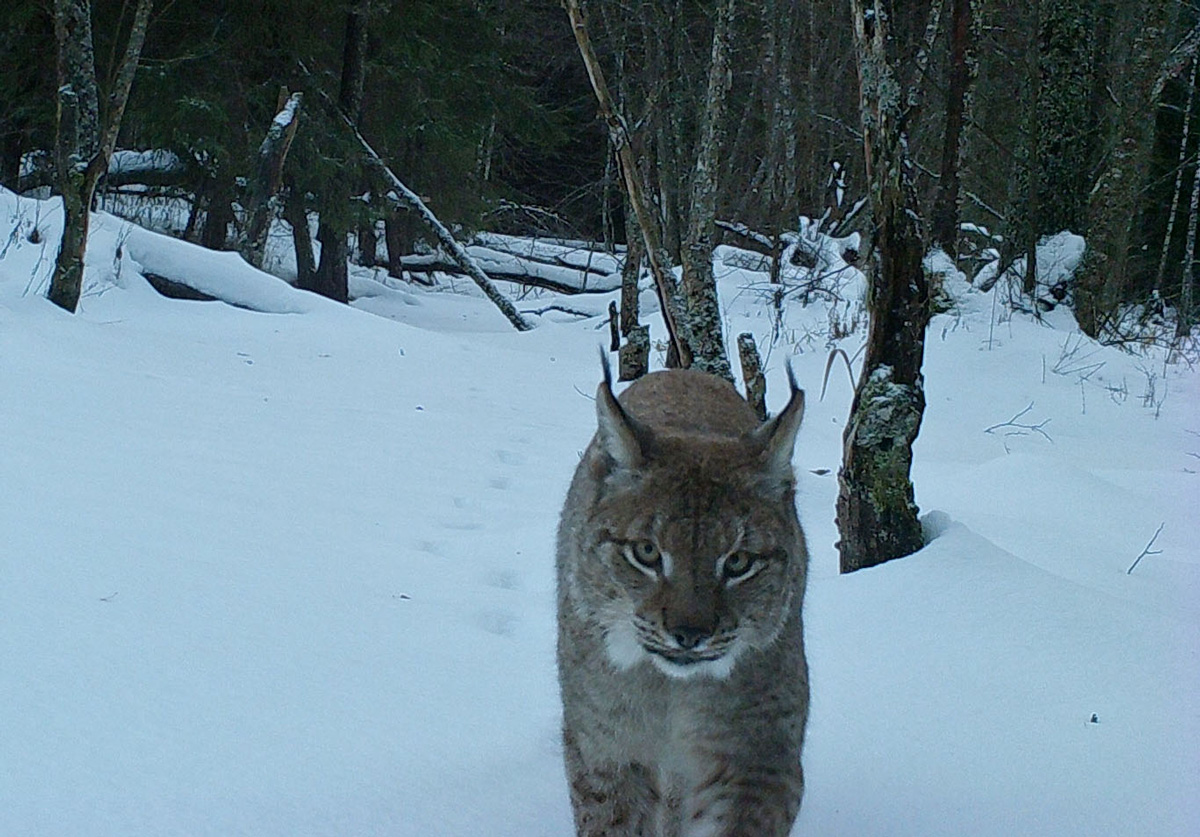
This post addresses the question of poorly known social contacts in the Eurasian lynxes exclusive of between-mate relationships and mother-kittens behaviour. In the book “Unknown Eurasian lynx Lynx lynx: New findings on the species ecology and behaviour” by Vadim Sidorovich, Jan Gouwy and Irina Rotenko (2019) we have stated that the species is not a solitary, but it is surprisingly social carnivore.
Peculiarity of usage of openings by lynxes

This post adverts the recent shift in the habitat-related lynx distribution for usage of openings and the lynx reaction to get back to forest in connection with the considerable changes in the wolf number in Naliboki Forest.
Continue reading “Peculiarity of usage of openings by lynxes”
Enigma of lynx pee

During quite a lot of studies on the Eurasian lynx in Naliboki Forest and Paazierre Forest we realized that this species is still so poorly known (Sidorovich et al., 2019). Even a simple lynx pee hides several non-studied questions that were raised during investigation the species behavior. Several curious pee-related phenomena were registered that was already some achievement, but for every one still there is a pressing question how such a pee regime is possible on a morph-physiological level i.e. by means of which morph-physiological adaptations of the species. Maybe somebody, after reading the post, will try to investigate the lynx pee questions.
Continue reading “Enigma of lynx pee”
Wolf erasing off marking points of lynxes

In Naliboki Forest adult lynxes particularly males are known as killers of the vulnerable categories of wolves such as pups, lonely living subadults and heavily pregnant females (Sidorovich et al., 2019). Also, lynxes may be a valuable competitor for wolves in their exploiting of the roe deer and beaver populations. Study on the interference of wolves and lynxes in Naliboki Forest suggested that wolves disagree with presence of lynxes in the habitats, and they behave aggressively towards lynxes, too. Lynxes feel safe in forest habitats, whereas they mainly avoid openings, when wolves are common in the habitats and where they may be killed by a wolf pack, because there are no trees to escape. Continue reading “Wolf erasing off marking points of lynxes”
The role and origin of open ground spots for large carnivores, wild ungulates and other wildlife

In snowless period spots with open sand, peat or other ground types are outstanding elements in the habitat structure in forested areas such as Belarus, and many mammal species tend to use them for territorial marking. Among these mammal species first of all it may be mentioned red deer, bison, wolf and lynx.
 Zoology by Vadim Sidorovich