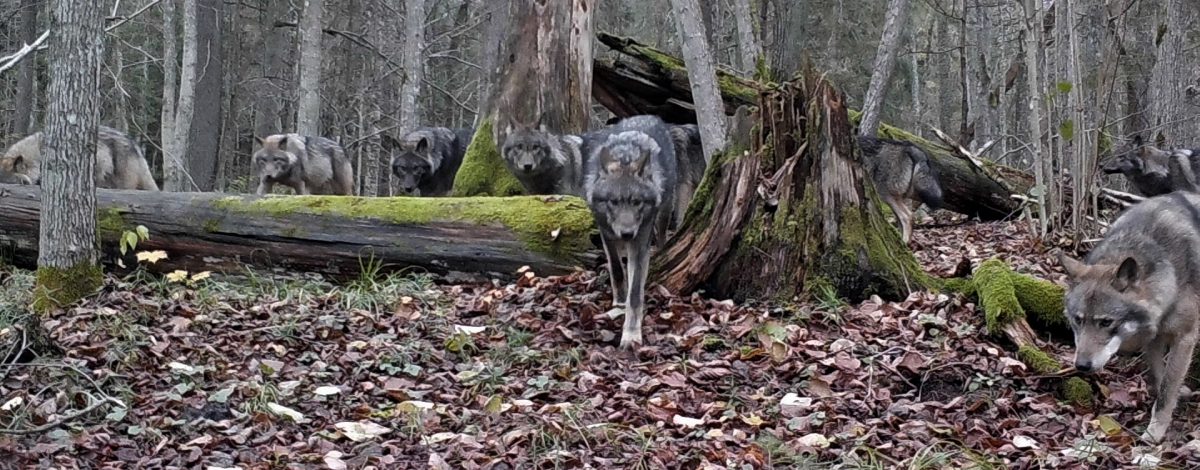

The behavior and ecology of the Eurasian lynx during the snowless season, particularly from the second half of April till the end of October (hereafter the warm season), is still searchless, and several important questions of study on the species in this seasonal period are seemingly even unknown. The main hassle is that the prevailing research method of GSM GPS telemetry fails to investigate those questions. Basically this method only records coordinates and how active or passive the individual is. It looks like currently the single possible way to learn about the behavior and ecology during the warm season goes through much routine habitat inspection, art skills to read activity signs of lynxes in snowless period and smart extensive camera-trapping.
Continue reading “Enigmatic warm-season behavior and ecology in Eurasian lynxes: pressing questions, hypotheses and results up-to-date”Tag: reproduction
The book on the wolf reproduction biology. Second edition.

Together with Irina Rotenko we recently published the second edition of the book on the wolf Canis lupus reproduction biology, which was based on the data gained in Belarus. There, we address the questions of the species mating, denning and raising of pups as well as mortality in wolf pups, which are still insufficiently investigated and full of contradicting hypotheses and knowledge. Therefore, the subtitle is “common beliefs versus reality”. However, the main thing for us in doing this book is to share the knowledge and skills we have gained on wolves in Belarus with wolf colleagues and amateurs.
In the second edition of the book we advanced all the former chapters basing on the results of the intensive study of wolf reproduction during spring-summer of 2018 and 2019 in Naliboki Forest. Also, we added one more chapter about the revealed trends in the denning behaviour of wolves in connection with the changes in the vertebrate community in Naliboki Forest.
Continue reading “The book on the wolf reproduction biology. Second edition.”The next step in the change of wolf denning habitats in connection with further increase in red deer and bison numbers in Naliboki Forest
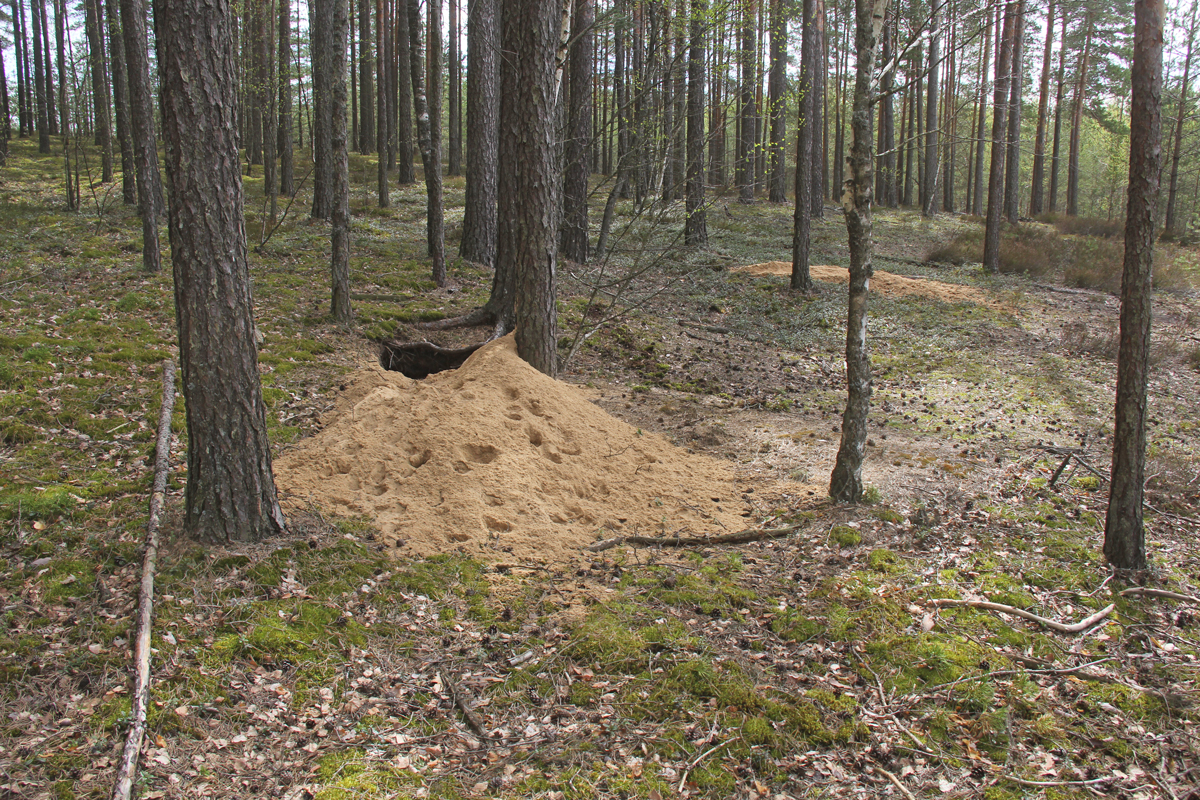
In June of 2018 there was post “Trends in the denning behaviour of the wolf and lynx in connection with the changes in the vertebrate community in Naliboki Forest (north-western Belarus)”, in which I described the changes in the denning behaviour of wolves and lynxes in connection with the population growth of the lynx, red deer, bison, and recovering of the badger population in the 2010s. It was shown that wolves with their prevailing of an open denning appeared in the hard situation to reproduce despite of the extra breeding efforts, first of all, with a pack multi-breeding.
Continue reading “The next step in the change of wolf denning habitats in connection with further increase in red deer and bison numbers in Naliboki Forest”Climbing trees by Eurasian lynxes to emit territorial and mating calls in Belarus: pressing questions and knowledge up-to-date

Another important role of trees in the life of lynxes is usage of elevated positions in tall trees to emit territorial and mating calls. During the winter of 2017-2018 in Naliboki Forest, the central-western part of Belarus we have found that lynxes climbed rather high Scotch pine trees (Sidorovich et al., 2018). In total, during February and March 2018, we registered four such trees, on which adult male lynxes climbed for about 17-26 meters high. The density of the local lynx population was very high about 4-5 inds per 100 square km i.e. about 80 lynxes per almost 2000 square km. We have evaluated that phenomenon of calling by lynxes from a tall tree top as a mating call, also taking into account that it was registered in the lynx mating season (mid-February-early April).
Then in Naliboki Forest in July 2018 we faced with several fresh climbing a tall pine presumably by adult female lynx (that was mother with two kittens), because the tree was in the core area, where this mother lynx with two kittens were staying most of the time.
Survival of the ten pups in that large wolf family in Naliboki Forest: an intermediate report
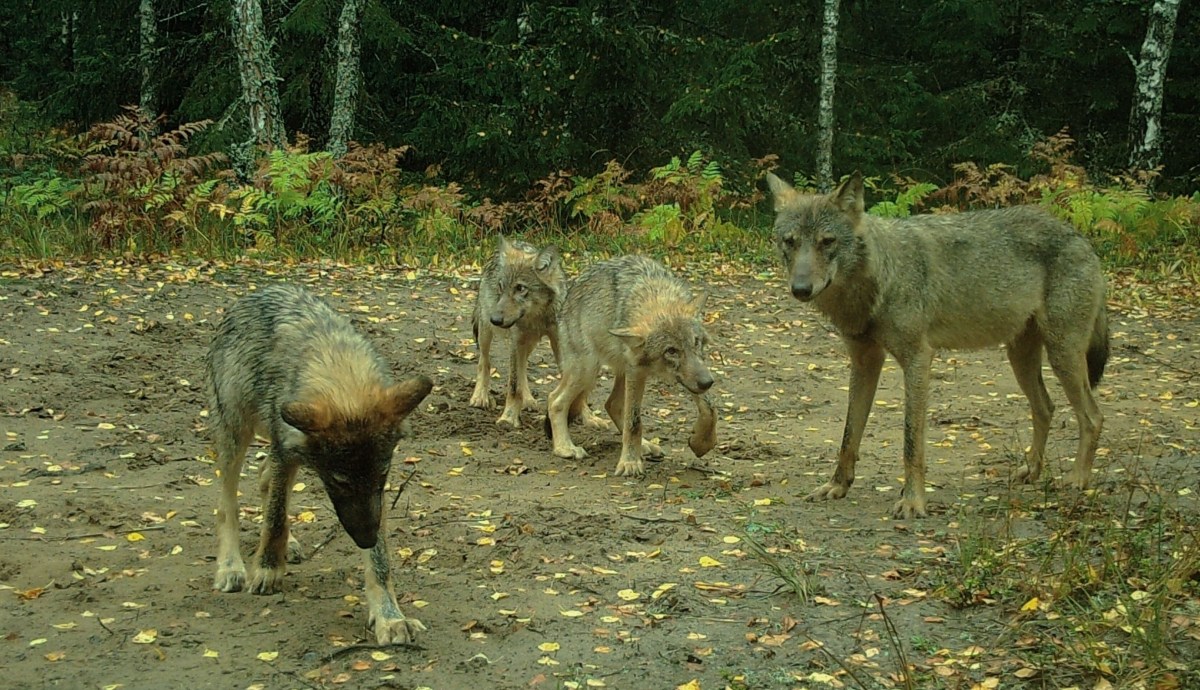
In one of the previous posts I reported about presence of the large family of wolves in Naliboki Forest that in the last July (i.e. July of 2018) consisted of founding male, two breeding females, two litters with ten pups altogether and two pup-sitters, which were almost all the time with the pups. Presence of these pup-sitters was connected with the extra care of parents to save pups from lynx attacks. The last years in Naliboki Forest in the conditions of the high number of lynxes (3-5 inds per 100 km2) wolf pup survival was very low; e.g. only about 4% of the wolf pups that were born in the spring of 2017 survived till the winter of 2017-2018. The occasions that wolf pups were killed by lynxes were numerically registered in Naliboki Forest earlier. Continue reading “Survival of the ten pups in that large wolf family in Naliboki Forest: an intermediate report”
Two wolf litters, two breeding females, founding male and two pup-sitters on a camera-trap in Naliboki Forest
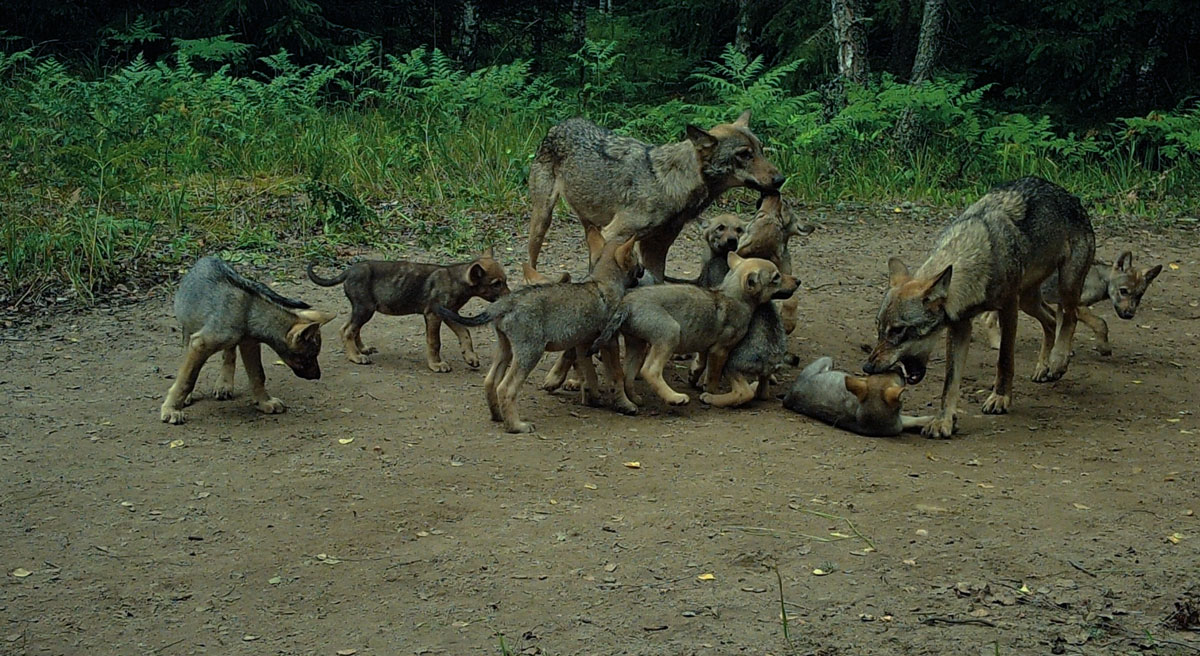
This post gives the documentation by a camera-trap of two different litters (10 pups altogether), two breeding females of the same wolf pack, the founding male and two pup-sitters in Naliboki Forest. The last feature is particularly essential. One or two pup-sitters were present at pups on about 60% of the hundreds of photos taken. It looks like we have registered the features of another trend in the wolf denning behavior that we haven’t faced with before the lynx got common. That is when breeding wolves use pup-sitters to save their pups from the lynx aggression (see another post for other details), when they go for hunting.
Mating in Eurasian lynxes

Mating in Eurasian lynxes and other questions in relation to that (such as pre-mating activity; life of kits, when their mothers go for mating; others) are quite poor investigated (e.g. Schmidt et al., 1997; Schmidt, 1999; Jędrzejewski et al., 2002; Breitenmoser-Würsten et al., 2007; Samelius et al., 2012). The scarce information published on the question shows that these complicated mating-related actions in Eurasian lynxes are too simplified, while researchers mention about mating in lynxes. Let’s say there is evident gaps in the lynx-related literature on the species mating.
Recently published book on the wolf reproduction biology
Together with Irina Rotenko we published a book about wolves in Belarus. There, we will address the questions of the species reproduction biology that are still insufficiently investigated and full of contradicting hypotheses and knowledge. However, the main thing for us in doing this book is that being interested in studying these hidden part of wolf life, we would like to … Continue reading “Recently published book on the wolf reproduction biology”
Together with Irina Rotenko we published a book about wolves in Belarus. There, we will address the questions of the species reproduction biology that are still insufficiently investigated and full of contradicting hypotheses and knowledge. However, the main thing for us in doing this book is that being interested in studying these hidden part of wolf life, we would like to share the knowledge and skills we have gained on wolves in Belarus with wolf colleagues and amateurs. Continue reading “Recently published book on the wolf reproduction biology”
Early denning behaviour and raising of pups after weaning in wolves

I would like to share our knowledge on the early denning behaviour and raising pups after weaning in wolves basing on the information that was gained in Belarus mostly in Naliboki Forest and Paazierre Forest.
The information is divided into two items: the first item is early denning behaviour in wolves; and the second one is raising of pups after weaning.
Continue reading “Early denning behaviour and raising of pups after weaning in wolves”
Social behaviour in lynxes in non-mating season
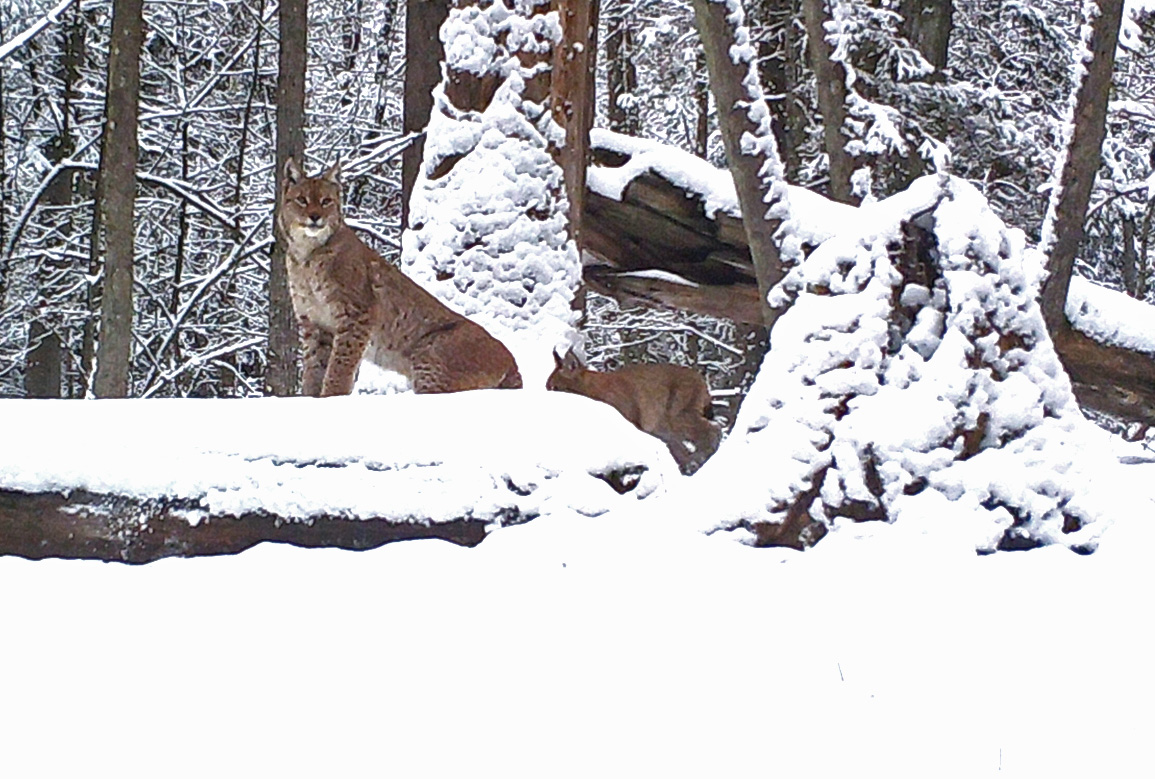
Lynxes are known as mainly solitary carnivores. Social contacts between adults are believed to be strictly limited to a mating season and within mother-kits family group. Continue reading “Social behaviour in lynxes in non-mating season”
 Zoology by Vadim Sidorovich