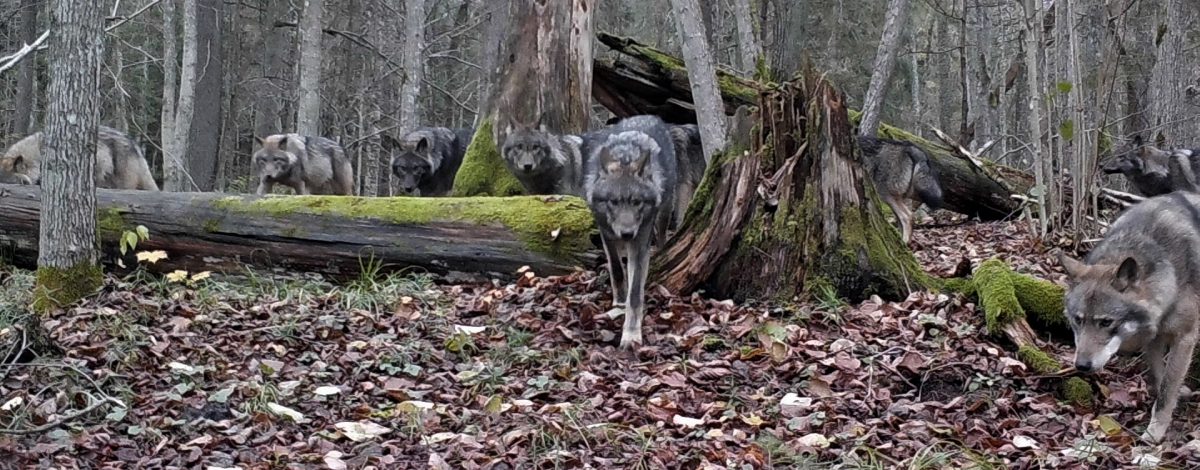

In one of the previous posts I reported about presence of the large family of wolves in Naliboki Forest that in the last July (i.e. July of 2018) consisted of founding male, two breeding females, two litters with ten pups altogether and two pup-sitters, which were almost all the time with the pups. Presence of these pup-sitters was connected with the extra care of parents to save pups from lynx attacks. The last years in Naliboki Forest in the conditions of the high number of lynxes (3-5 inds per 100 km2) wolf pup survival was very low; e.g. only about 4% of the wolf pups that were born in the spring of 2017 survived till the winter of 2017-2018. The occasions that wolf pups were killed by lynxes were numerically registered in Naliboki Forest earlier. Continue reading “Survival of the ten pups in that large wolf family in Naliboki Forest: an intermediate report”
Tag: lynx
Why do lynxes visit road pipes?

In Belarus lynxes quite often visit road pipes. In the warm season, they mainly use road pipes without running water. In winter, when water is covered with ice, almost all pipes that are large enough are in lynx usage.
Trends in the denning behaviour of the wolf and lynx in connection with the changes in the vertebrate community in Naliboki Forest (north-western Belarus)

By investigating the denning behaviour and ecology of wolves (Sidorovich and Rotenko, 2018) and lynxes in Naliboki Forest, we faced with several evident trends during the last years (2016-2018) that we connect with the changes in the local vertebrate community or more specifically with the pronounced changes in the population densities of those species that may affect the denning conditions for wolves and lynxes.
Continue reading “Trends in the denning behaviour of the wolf and lynx in connection with the changes in the vertebrate community in Naliboki Forest (north-western Belarus)”
Mating in Eurasian lynxes

Mating in Eurasian lynxes and other questions in relation to that (such as pre-mating activity; life of kits, when their mothers go for mating; others) are quite poor investigated (e.g. Schmidt et al., 1997; Schmidt, 1999; Jędrzejewski et al., 2002; Breitenmoser-Würsten et al., 2007; Samelius et al., 2012). The scarce information published on the question shows that these complicated mating-related actions in Eurasian lynxes are too simplified, while researchers mention about mating in lynxes. Let’s say there is evident gaps in the lynx-related literature on the species mating.
Scaring lynxes away from their kills by wolves

Recently I faced with the next fourth case of scaring lynxes away from their kills by wolves and decided to prepare this post about this curious way of the species interference. This fourth registered such a story was outstandingly rich on events and relatively well photo-documented, therefore, I will begin just with that story.
In the story the main acting persons were Els Lavrysen and Hans Van Loy, a couple of lynx amateurs from Belgium, who faced the case of scaring lynx family away from the roe deer carcass by two wolves in Naliboki Forest (the central-western part of Belarus). Continue reading “Scaring lynxes away from their kills by wolves”
Mortality in wolf pups

The main monograph on the grey wolf by Mech and Boitani (2003), which still provides the basic and unequalled knowledge on the species biology, informed the following. “Almost 30 years ago, Keith (1974) concluded that “the factors which provide wolf pup mortality during the first 5 months are almost wholly unknown. This is probably the single greatest enigma in wolf biology today.” Though some strides have been made toward identifying these factors, this is still a much needed area of research.”
While reading this in 2004, we already were much aimed by the question. Moreover, the opportunity to find out something really new in the wolf biology accelerated these our research efforts. Nowadays, we may say that, at least, for the region of Belarus mortality in wolf pups is known more or less. Also, we assume that the factors, which impact the survival of wolf pups in Belarus, act in other regions of European forest zone. At the same time, we suppose that the only main causes of wolf pup mortality were found out, whereas many smaller questions remain unresolved.
Distribution patterns and habitat combinations inhabited by lynx in Belarus

In Belarus there are three main types of habitat combinations that are mostly inhabited by a local population of lynxes. So, such a habitat combination should include not only suitable habitats for living of a lynx, but also it should have enough space for many lynxes, where there are sufficient carrying capacity, first of all, prey species i.e. food.
Continue reading “Distribution patterns and habitat combinations inhabited by lynx in Belarus”
Social behaviour in lynxes in non-mating season

Lynxes are known as mainly solitary carnivores. Social contacts between adults are believed to be strictly limited to a mating season and within mother-kits family group. Continue reading “Social behaviour in lynxes in non-mating season”
Findings on the interference between wolves and lynxes

aReading literature and talking with wolf and lynx researchers, it becomes evident that interference between the two species is actually poorly studied. Some mammalogists tend to assume that wolves suppress the lynx population. Some even suggest details of the aggressive behaviour of wolves towards lynxes: strong wolf packs attack lynx family groups and kill kits during lynx mating season when the kits stay alone or disperse. Seemingly, such stories are only speculative beliefs and ideas. Continue reading “Findings on the interference between wolves and lynxes “
Difference in hunting styles of lynxes between the warm and cold season with implication for the home range structure
We have found a great difference in hunting styles of lynxes between the warm and cold seasons. In the cold season, particularly during the snow period lynxes hunt mostly by walking i.e. patrolling prey-rich habitats and suddenly attacking prey. In the warm season lynxes mainly wait for prey from a hide over prey pathway. Such … Continue reading “Difference in hunting styles of lynxes between the warm and cold season with implication for the home range structure”

We have found a great difference in hunting styles of lynxes between the warm and cold seasons. In the cold season, particularly during the snow period lynxes hunt mostly by walking i.e. patrolling prey-rich habitats and suddenly attacking prey. In the warm season lynxes mainly wait for prey from a hide over prey pathway. Such waiting usually lasts about ten and more hours. Continue reading “Difference in hunting styles of lynxes between the warm and cold season with implication for the home range structure”